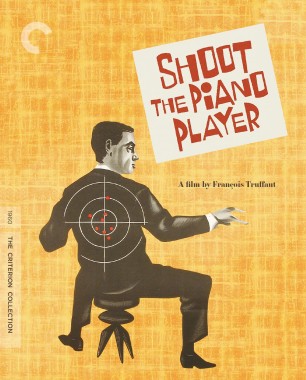
Shoot the Piano Player: You’ll Laugh, You’ll Cry

François Truffaut’s heyday as an eternally youthful hero of international cinema now seems almost as distant in memory as dial telephones or Bibles in hotel-room desk drawers. Between his explosive emergence with The 400 Blows in 1959 and his death in 1984 at the age of fifty-two, Truffaut was one of the busiest and most prolific filmmakers alive. For many, he came to represent the very spirit of cinema itself—his love for and fierce devotion to the art form seemed to illuminate him from within. Truffaut was so beloved and celebrated throughout the world that it became fashionable and almost required for cinephiles, film students, and certain young filmmakers to reject him as they had rejected Ingmar Bergman and Federico Fellini. Truffaut was “commercial”; he made the kinds of “tradition of quality” movies he railed against as a critic; his films went down “too smoothly”; and so on.
He and Jean-Luc Godard were the two dominant figures of the French New Wave, and their opposition was intensified by the bitter war of words that brought their close comradeship to its sad end. As Truffaut rose with each new film to greater prominence, Godard turned to video (in collaboration with his partner, Anne-Marie Miéville) and withdrew from anything remotely resembling standard filmmaking practice throughout most of the seventies. But all these years later, both men are gone, and so are the clichés and contingencies and prejudices of their shared lifetime. Now we can look at their individual works with fresh eyes. I think that Godard’s films will always be new to us. But to revisit Truffaut’s oeuvre in the context of the contemporary film world might just come as a shock.
The idea of Truffaut as a purveyor of lighter-than-air Gallic sophistication in a literary key always felt off to me. Now it just seems like an invention, conjured from the ideological weights and counterweights of post–May ’68 culture. His sprung rhythms and sheer energy have always felt liberating, and so has his pursuit of narrative surprise: every new scene in a Truffaut movie turns suddenly on a dime. But what strikes me now is his pursuit of an extremely unusual emotional valence. From the first shorts through Confidentially Yours (1983), his films are uniformly tuned to a special frequency hovering between impulse, memory, and self-control, with little pockets of space left for stinging upsets and turnabouts. The work is less “humanistic” than absolutely human—unnervingly so. The borderline neurotic intimacy, the undercurrents of madness, and the precarious proximity of life and death, married to the instincts of a true entertainer, make for one of the wildest artistic temperaments in the wild universe of postwar cinema.
If there is a skeleton key to Truffaut’s oeuvre, it is Shoot the Piano Player (1960), the film in which all of his assorted gifts and preoccupations are in play and meshed into a uniquely idiosyncratic whole. The film offers powerful evidence of his love of American cinema and literature (this is far and away the most successful of his five adaptations of American pulp fiction), as well as of his career-long concerns with doomed romances and hardened but spirited children. There is that wonderful speed, a pleasure in and of itself, that amounts to a kind of worldview—actions, objects, places, and sensations glimpsed and seized on, almost spontaneously forming a vivid afterimage in the mind’s eye. And his high-velocity storytelling is intimately tied to the feeling of impending mortality, the sense of every given moment in time coming and going, never to return. As for surprise, Shoot the Piano Player is about as unpredictable from one moment to the next as any film I know—from the subtitled singer (Boby Lapointe, who was introduced to Truffaut by the writer Jacques Audiberti) to the expiring mother. Most famously of all, it is a film about a type of emotional reticence that is almost too delicate to pin down in words. To call Shoot the Piano Player the story of a “shy person,” as Truffaut himself did, is only to touch on the emotional depths of Charles Aznavour’s Charlie Koller/Edouard Saroyan. Perhaps he is less shy than hesitant at the moment of truth, forever surging with inspiration only to halt and retreat into doubtful reflection. It is a rhythm of life to which many of us are accustomed but to which few of us would admit, and Truffaut was far ahead of his time in building an entire movie (let alone a crime movie!) around this tricky emotional dynamic. Aznavour’s piano player anticipates a whole range of modern movie characters, from Warren Beatty’s Clyde Barrow (Truffaut was the first choice of screenwriters Robert Benton and David Newman to direct Bonnie and Clyde, on the basis of Shoot the Piano Player) to Robert De Niro’s Travis Bickle to Robert Forster’s aging bail bondsman in Jackie Brown to the eternally reticent heroes of André Téchiné and Arnaud Desplechin. At this point, it must be said that Truffaut and Aznavour’s creation seems no less fresh today than it did in 1960.
One thing’s for sure—it seems far less bewildering over half a century later, at least to French viewers. “Is the film more comic than tragic?” a journalist asked Truffaut, following the film’s disappointing to disastrous reception by the critics and the public (not to mention the censors). “It’s both,” he answered. “With Piano Player, I wanted to make women cry and men laugh.” A flippant answer to a typically single-minded journalist’s question, but the sureness of the response is matched by the sureness of the execution of the film itself. There is nothing tentative or unachieved in what is, after all, the sophomore effort of a young director. “How sure is Truffaut’s command of cinematic language!” Joseph McBride once wrote of Fahrenheit 451 (1966); and the same could be said of the director’s abilities with actors, narrative, and the balance of endlessly shifting moods—in this case, antic comedy, ruminative reserve, romantic longing, and tenebrous regret.
In the spring of 1959, Truffaut was hard at work with Godard on an adaptation of Jacques Cousseau’s Hot Weather, to star Bernadette Lafont. At the last minute, reckoning that neither French cinema nor the New Wave needed yet another film about young love, he switched gears and turned to David Goodis’s 1956 novel, Down There, published in France as part of the Série noire collection. Goodis, whose novels have provided source material for filmmakers as disparate as Delmer Daves (Dark Passage), Jacques Tourneur (Nightfall), Jean-Jacques Beineix (The Moon in the Gutter), and Samuel Fuller (Street of No Return), was a favorite of Truffaut’s. He found in Goodis a singular mixture of the hard-boiled, the romantic, and the fantastic. “At a certain point,” Truffaut said of Goodis’s books, “they go beyond the usual gangster story and become fairy tales.” Truffaut was also enchanted by the fact that no matter what transpires in the stories—murder, kidnapping, suicide—“the men speak only of women, and the women speak only of men.” Truffaut’s idea was to marry Goodis to the stop-start rhythms of the comic novelist Raymond Queneau, creating a film that was “practically a musical.” This unusual idea caused him no small headache during the editing, due less to confusion than to nervousness at trying to pull off something so new.
Truffaut said that it was a single image from Goodis’s novel—the car silently approaching the house in the snow, where Saroyan’s crazy brothers are holed up—that sparked him to make the film, and Truffaut and cinematographer Raoul Coutard do indeed give the image a very special kind of quaintly miniaturized beauty. But I have a feeling that it was the image of Aznavour himself in the lead, complemented by the heartbreakingly beautiful Claudine Huzé (Truffaut gave her the stage name Marie Dubois) as the devoted and doomed Léna, that turned all the lights green for him. In Aznavour, he saw a countenance that recalled Saint Francis. But it’s a sure bet that he also saw what his friends recognized right away—a face and a charmingly reserved manner that recalled his own. Somehow, the mixture of shyness and confidence in the figure of the forlorn piano player provides us with a perfect mirror for Truffaut himself, whose films are so rich, vibrant, and eminently enjoyable that one is continually caught off guard by the realization of their complexity, their bravery, and their emotional depths.
This essay is an updated version of a piece that originally appeared in the Criterion Collection’s 2005 edition of Shoot the Piano Player.
More: Essays
Nouvelle Vague: Insolent Like No One Else
In this exhilarating account of the making of Jean-Luc Godard’s Breathless, Richard Linklater lovingly reconstructs the vanished world of late-fifties Paris and the cinephilic culture surrounding the French New Wave.
Little Odessa: He Ain’t Heavy, He’s My Brother
James Gray’s extraordinary debut feature is a painstakingly distilled tale of crime and family dysfunction, captured with a merciless gaze and a sharp attention to idiosyncratic detail.
American Dream: The Time Is Right
In her second film, Oscar-winning documentarian Barbara Kopple captures the anguish and perils of disunity in the labor movement and the corrosion of union power during the Reagan era.
Five Radical Documentaries by Kazuo Hara and Sachiko Kobayashi: Restlessness Refusing Resolution
The pioneering husband-and-wife duo transformed the field of Japanese nonfiction cinema with their portraits of spectacular, edgy personalities and collectives under duress.