At the beginning of Cruel Story of Youth (1960), the title splashes across the screen in fiery red. Each of the three Japanese words that appear offers a key to understanding director Nagisa Oshima’s breakthrough film and the energies that led to its making.
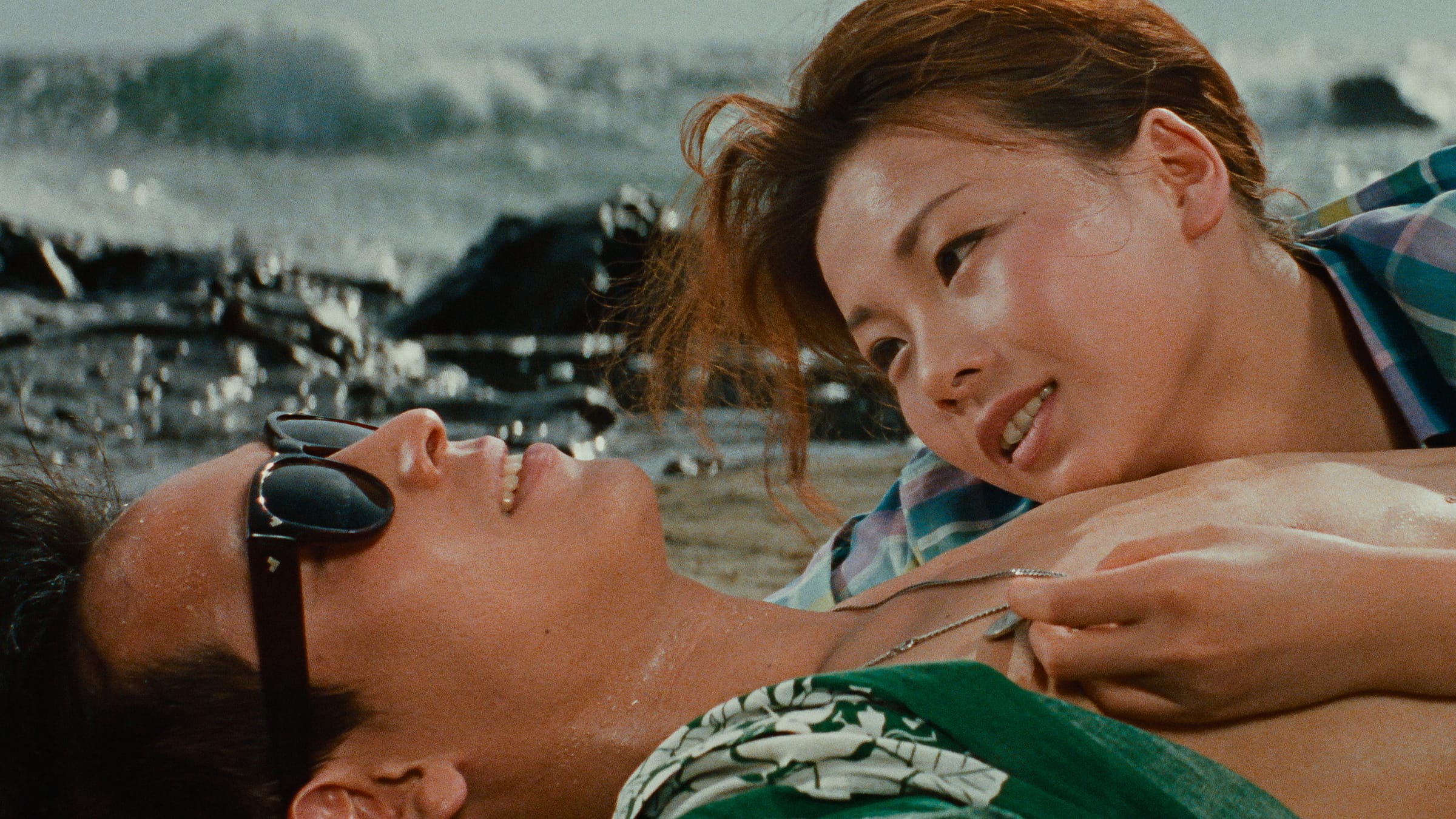
Seishun (youth) links Cruel Story to a pop-culture phenomenon of its era: the wave of taiyozoku-eiga (sun tribe films), launched by the 1956 screen adaptations of Shintaro Ishihara’s novels Season of the Sun and Crazed Fruit. These works, which glamorized the disaffection of Japanese adolescents, became the target of public accusations of immorality and were a focus of cultural commentary claiming a generational breakdown in Japanese society. Cruel Story of Youth contains some typical features of the sun tribe films and other contemporary Japanese movies about young people, including themes of prostitution and abortion; the iconography of motorbikes, motorboats, and Hawaiian shirts; and a male protagonist given to fits of violent rage.
Monogatari (story), a word that frequently appears at the end of Japanese literary titles, could be read as an indication that Oshima, though very much a modernist in his style and choice of subject matter, was offering a film situated within the traditions of classical narrative cinema. Indeed, his title for the first draft of the script, Awakening of Love and Humanity, seemed to promise a work that would share the humanist idealism of one of Shochiku’s star directors, Keisuke Kinoshita.
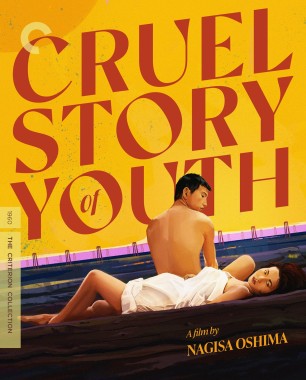
The word that lays Oshima’s true intentions bare is zankoku (cruelty). Shochiku had disapproved of the ending of Oshima’s first film, A Town of Love and Hope (1959), finding it too “cruel.” In preparing his follow-up, Oshima took his employer’s objections to heart and, instead of softening his attitude, resolved to go further in his portrayal of “cruelty” as “the essence of the present.” Awakening of Love and Humanity became Cruel Story of Youth, a film that sees the situation of young people in an increasingly affluent and conservative Japan in terms of two kinds of cruelty—that which attacks them from the outside, and that which they summon from within in a doomed attempt to defend and assert themselves. The word cruelty also defines the director’s approach. Determined to “destroy the old naturalist methods” of Japanese cinema, Oshima wages a battle against them on all fronts: narrative, representation, image, sound.
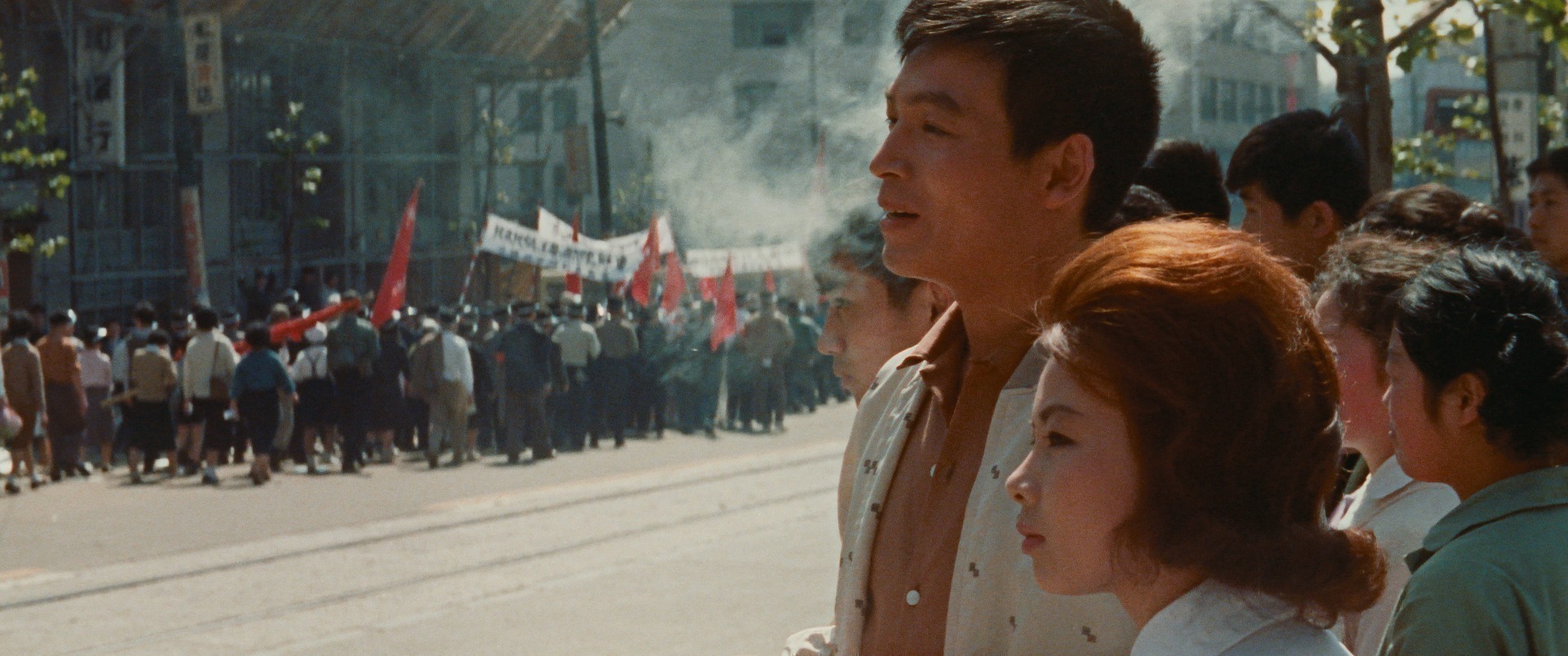
Oshima builds Cruel Story of Youth in bold, elliptical strokes. The film follows two lovers: university student Kiyoshi (Yusuke Kawazu) and third-year high-school student Makoto (Miyuki Kuwano). Their revolt against society takes the degraded form of a serial con they run on middle-aged businessmen. Makoto serves as bait, enabling Kiyoshi to catch the men as they try to bring her into love hotels and giving him the chance to extort money from them. The political context of the couple’s delinquency is broadly but forcefully defined. Early in the film, Kiyoshi and Makoto watch a street demonstration against the renewal of the U.S.-Japan Security (Anpo) Treaty. The pair stand on the sidelines without participating, as if unable to see how organized action could transform their lives. The film goes on to suggest that political apathy is a historical consequence of the failure of the early postwar period’s left-wing struggles, in which Oshima himself took part as a student at Kyoto University in the early 1950s. It is likely that he saw something of himself in one of the film’s secondary characters, the clinician Akimoto (Fumio Watanabe, who would go on to be one of Oshima’s favored actors), an idealist who has lost his belief in the possibility of revolutionary change.

The society for which Kiyoshi and Makoto feel instinctive hatred hardly bothers to constrain them. Makoto’s father (Jun Hamamura) explains his refusal to exert authority over her by saying that, in light of Japan’s social decline, it’s no longer reasonable to expect individuals to behave morally. Makoto’s school seems to be run with a similar laissez-faire approach, as can be discerned from the laid-back body language of her cigarette-smoking homeroom teacher (Toshiko Kobayashi). With nothing keeping her on the straight and narrow, Makoto gets drawn into Kiyoshi’s world, whose two bases are a bar frequented by sleazy underworld types and the small apartment he and his roommate (Shinji Tanaka) take turns using for trysts with girlfriends.
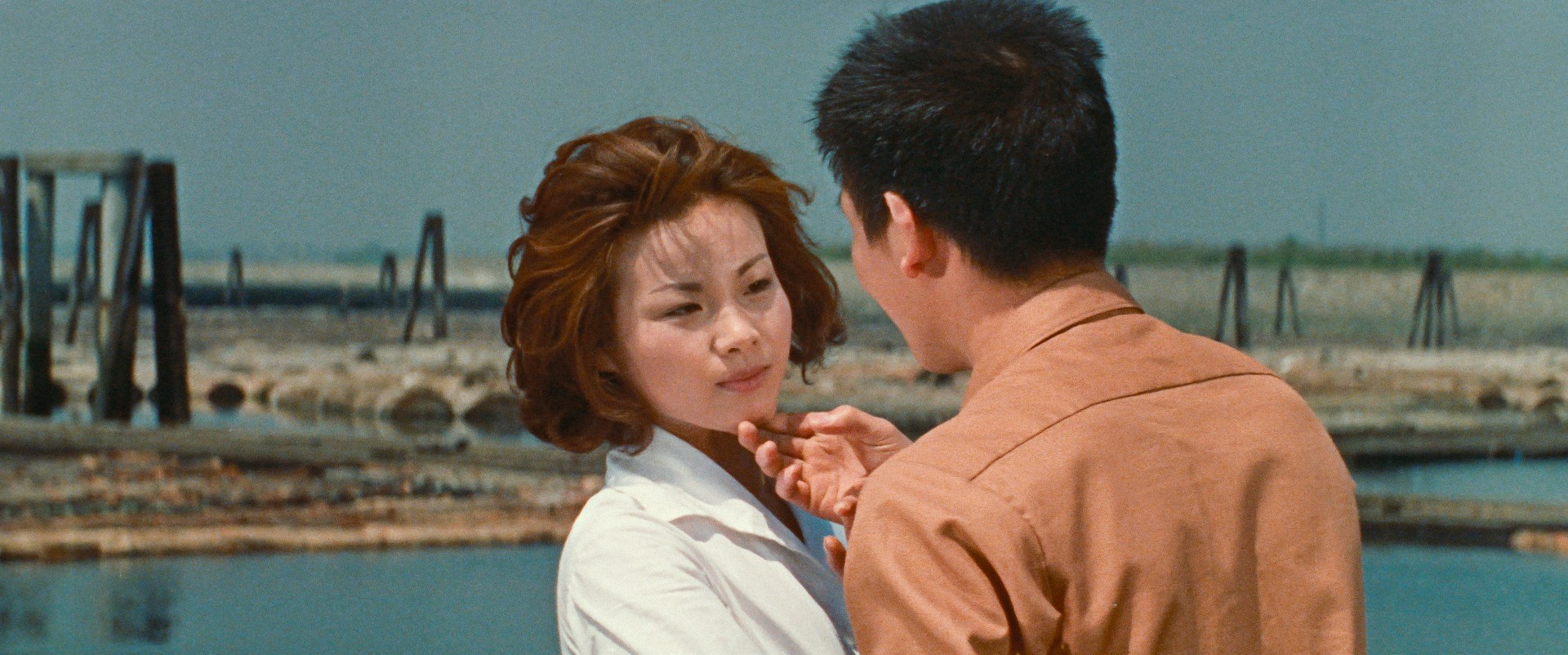
Within this atmosphere of indifference, violence, and discontent, the love between Kiyoshi and Makoto develops like a mutation. In one of Cruel Story’s most memorable sequences—which, thirty-five years later, Oshima included in his British Film Institute–commissioned documentary 100 Years of Japanese Cinema—Kiyoshi and Makoto go to a log pier at Tokyo Bay. Long shots emphasize the stillness and depopulation of the site. Riichiro Manabe’s eerie modernist score suggests that the world is in a trance. As Kiyoshi fondles the barely conscious Makoto, Oshima cuts to the image of a dull sun. It casts a listless mood, which the assault that follows seems to maintain rather than rupture. If the sun, as Oshima later explained in an interview, is an evocation of the Anpo protests (a link reinforced by the dubbed-in sound of a passing airplane), then Kiyoshi’s rape of Makoto can be understood both as a revelation of the discreet violence of Japan’s rightward shift and as a misdirected protest against it. The camera tilts down to the logs, along which the camera tracks calmly toward Makoto, who is lying face up, Kiyoshi’s shirt spread over her body, as Kiyoshi dives naked into the water. Throughout this lengthy sequence, music, camera movement, and elliptical cutting create psychological distance and point toward inexorable, if invisible, external forces.
The push-pull effect of Oshima’s style here is characteristic of a film that, from beginning to end, declares the independence of its author. Putting human figures at the edge of the GrandScope frame and filming them in uncomfortable close-ups that often seem about to fracture, Oshima highlights the instability of his characters’ relationships with one another and with their surroundings. By omitting transitional shots and explanations, Oshima sets the characters adrift in space and time, forcing viewers to drift with them. The visual flatness created by cinematographer Takashi Kawamata’s telephoto lens adds to the unmoored and abrupt quality of the narrative. In exterior long takes, the warmth of very-early-morning light defamiliarizes the garishness of hyper-commercial Tokyo, while the director makes known his opposition to institutional preference by using a handheld camera (as Oshima later noted, “at Shochiku at that time . . . the thing they hated the most was images shaking”).

Oshima’s use of color in Cruel Story of Youth manages to be at once lurid and austere. The early sections of the film are emphatically red: you see the color in everything from the main titles to a pair of parked cars featured in the opening shot to the flags that fill the screen during the protest scene. Eventually, red becomes the color most closely associated with the central couple. After Kiyoshi has raped Makoto a second time (taking out on her his shame over the financial victimization he has just suffered at the hands of a group of pimps), Makoto thinks she sees in Kiyoshi’s face that he loves her. Oshima shoots this moment of recognition against a dislocated blackness in which two blurry red lights gleam as if signaling distress.
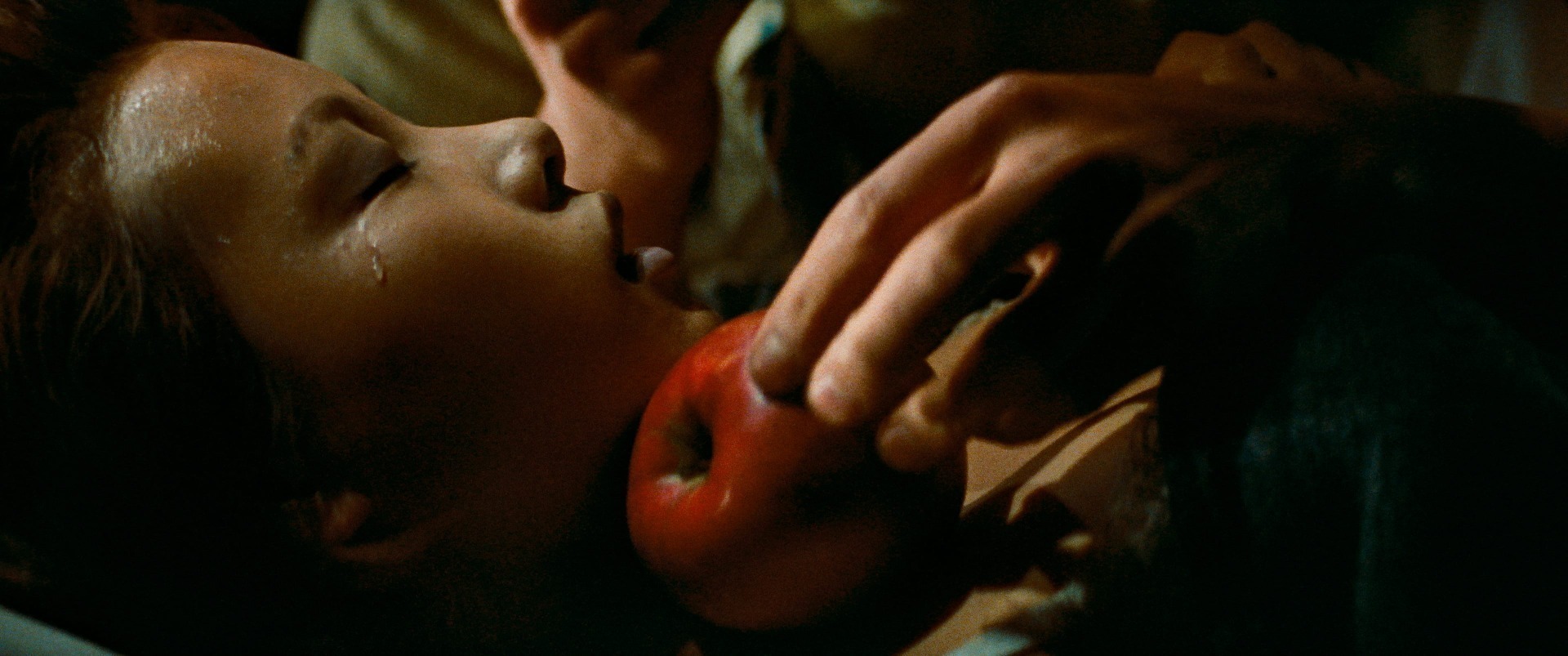
After Makoto tells Kiyoshi that she is pregnant, he arranges for her to have an abortion at Akimoto’s clinic. Visiting her after the procedure, Kiyoshi takes two apples from a paper bag—one red, one green. Kiyoshi greedily devours the green one (“as if chewing on the pain of youth,” Oshima wrote in the shooting script), but not without first placing the red one under the sleeping Makoto’s chin as a sign of love. Oshima, who later said of this scene that it caused his heart to leap, captures all this in the movie’s longest take, putting Kawazu’s strength of concentration to the test and forcing viewers to respond to Kiyoshi’s hopeless passion for freedom.
Oshima’s vigorous and astringent style won the approval of critics, who were quick to compare Cruel Story of Youth to the French New Wave films that had premiered in Japan during the months before its release. Nine other Shochiku productions made by young directors acquired the label nuberu bagu when they appeared later in 1960: in addition to Oshima’s next two films, The Sun’s Burial and Night and Fog in Japan, there were Yoshishige Yoshida’s Good-for-Nothing and Blood Is Dry, Masahiro Shinoda’s One-Way Ticket to Love and Dry Lake, Tsutomu Tamura’s Volunteering for Villainy (a.k.a. The Samurai Vagabonds), Osamu Takahashi’s Only She Knows, and Eitaro Morikawa’s The Tragedy of Bushido. Though Oshima objected to the “new wave” tag as a code phrase advertising sex and violence, he also acknowledged that before starting production on Cruel Story of Youth he had seen Jean-Luc Godard’s Breathless (1960), which he admired for the director’s “active involvement” and for the way the film reveals “the continuity of discontinuity.” In Cruel Story of Youth, Oshima chooses the milieu, the situations, and, broadly speaking, the form of a crime film for the same reason Godard does in Breathless: to highlight the incoherence of the main characters’ relationship to their society while showing how this incoherence contaminates their relationship to each other.
The two directors are similar in their awareness that a film is, as Oshima put it, “a document of its actors.” As much as Jean-Paul Belmondo in Breathless, Kawazu represents a kind of international masculinity that was in vogue in the year 1960. Though his veneer of swaggering derision is thinner than Belmondo’s—and though he seems amused by other people, while Belmondo’s humor arises from his amusement at himself—Kawazu is no less convincing than Belmondo in embodying the restless, predatory nature of youthful male rebellion. His affectless performance, eschewing conventional signifiers of anguish and emotional release, frustrates the viewer’s efforts to sympathize with Kiyoshi but bears the stamp of reality.

Meanwhile, Kuwano’s performance (like that of Jean Seberg in Breathless) creates a continuity of feeling and purpose that conveys an intense indifference to the traps the screenplay sets for her character. As one of the pimps spins her around brutally in the bar, Makoto withdraws into an alcoholic haze, whose space and rhythm the actor delineates with the same automatic cool that later marks the character’s growing mastery of the gestures of cigarette smoking. More than twenty years after its release, Oshima watched a TV broadcast of Cruel Story of Youth and was surprised to find that “even in the contemporary era, when women have changed completely, Miyuki Kuwano’s role was drawn so carefully that it still held up. Clearly, by the final scenes, the woman is the stronger one. She asserts herself properly. That was really a self-discovery for me, revisiting it.”
In the end, Kiyoshi gives his life to protect Makoto from being prostituted by a gangster (Kei Sato) and his hoods. Paradoxically, this act of self-sacrifice happens right after Kiyoshi breaks up with her, saying he sees no way for them to avoid ending up as mere things to be sold and consumed. Here lies the crucial contradiction of the film. Unable to avoid this fate, the couple perversely embrace it. Makoto, who has hated turning herself into a thing for sale to carry out their scheme, now proposes that they put it into action one more time. This decision leads to a bloody finale, shot and cut with relentless brilliance, in which Oshima anticipates the intertwining of love and violent death in his later masterpieces such as The Man Who Left His Will on Film (1970), In the Realm of the Senses (1976), and Merry Christmas Mr. Lawrence (1983).
Looking back on the months of artistic concentration and political upheaval that saw the creation of Cruel Story of Youth, The Sun’s Burial, and Night and Fog in Japan, Oshima remarked that “the year 1960 determined my entire cinematic life.” Each of the great films he made that year points toward key aspects of his later achievements, but it is the first of the three that, through its rawness, ferocity, and glimmers of tenderness, captures the richest sense of freedom and discovery.
More: Essays
Hud: No Place for Heroes
A career-altering artistic breakthrough for director Martin Ritt, this dark tale of a family’s downfall daringly exposes the mythology of the western hero as empty and morally bankrupt.
Alice Doesn’t Live Here Anymore: At Home in the World
Made in close collaboration with its star, Ellen Burstyn, Martin Scorsese’s first film for a major studio is a warm, openhearted portrait of a woman who endeavors a drastic reshaping of her life.
The Crying Game’s Legacy as Transgender Representation
Though it became the subject of cultural hysteria upon its release in 1992, Neil Jordan’s film can be appreciated today as a rare and remarkably nuanced depiction of a cisgender man and a trans woman falling in love.
The Crying Game: Identity Crises
Neil Jordan achieved major international success with this complex exploration of identity and desire set against the turbulence of the Troubles in Northern Ireland.