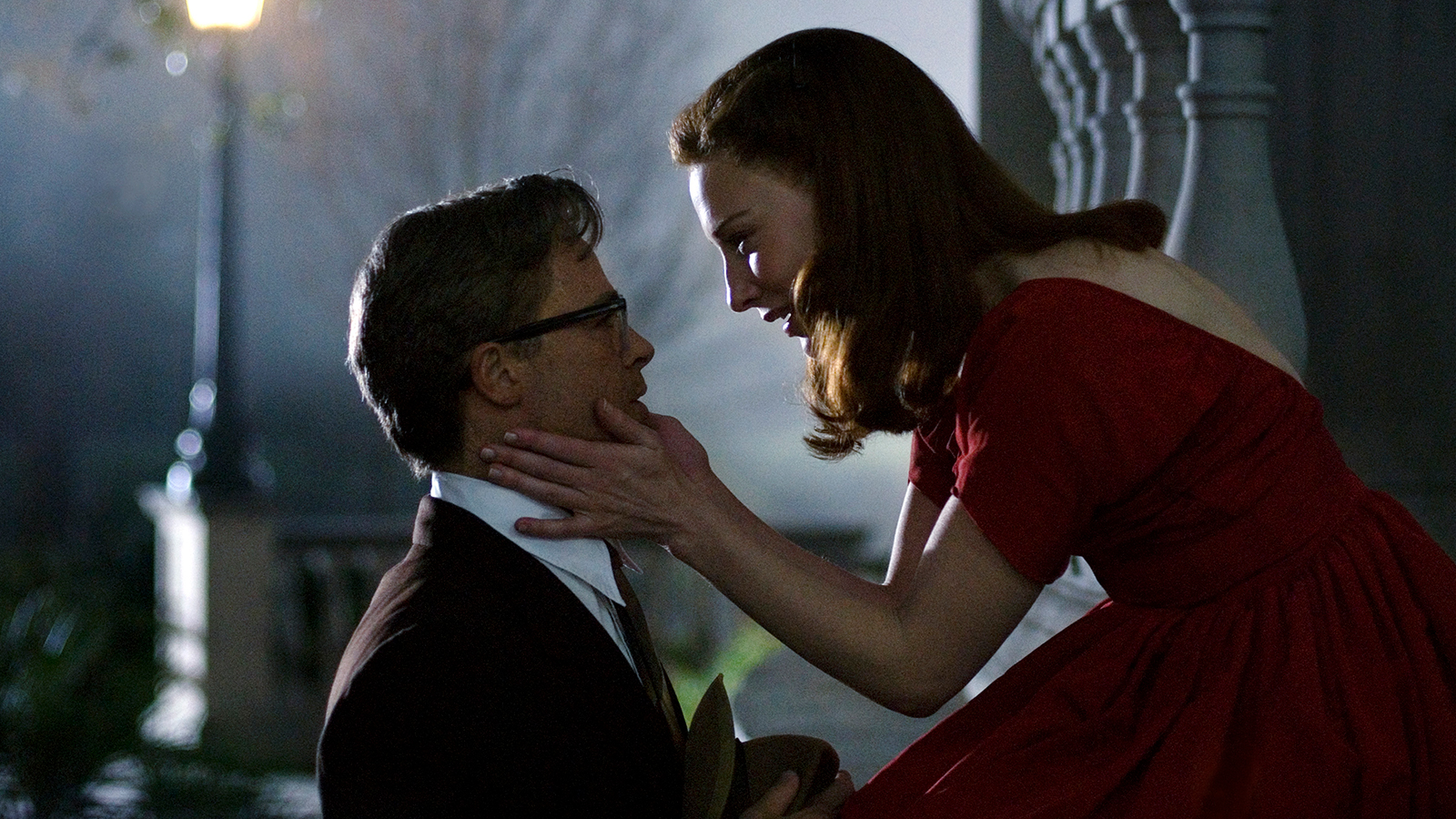
There are few careers in big-time modern American moviemaking like David Fincher’s. Where almost everyone else in the last two decades has felt obliged to define him- or herself right out of the gate, Fincher has evolved from movie to movie. If you were to go back and look at Se7en or The Game in light of the director’s recent work, you would see the same refinement of light and space, the same level of emotional engagement with his actors, the same narrative precision, even the same aura of melancholy. One might have reckoned that the director of Fight Club and Panic Room would become one of the key artists of the digital age. (Indeed, from the beginning it was obvious that Fincher’s creativity and audacity were matched by his technical know-how.) I don’t think any of us, however, would have guessed that Fincher, with Zodiac and The Curious Case of Benjamin Button, would achieve a vision of time so heartbreakingly acute as to rival those of John Ford and Orson Welles.
Every second of Benjamin Button, every shot and every cut, every gesture and every facial expression, every turn in its narrative and every visual effect, is devoted to the contemplation of time’s passing. Of course, that is the theme of Eric Roth’s screenplay, an epic embellishment of F. Scott Fitzgerald’s wisp of a story about a man who is born old and grows young, displaced from Baltimore to New Orleans and shifted ahead fifty years in time. And it is easy to imagine the film directed by someone else, anyone else apart from Fincher, and made into a poignant love story about two people who “meet in the middle,” set against the backdrop of the American century. I’ve read many descriptions of this phantom movie, Roth’s script as directed by Ron Howard or Nora Ephron. They are very far from the mysterious and troubling film Fincher has actually made.
The narrative is a flashback invoked through readings from Benjamin’s diary by a young woman to her mother, Benjamin’s great love, Daisy, as she lies on her deathbed in a New Orleans hospital. The action officially “takes place” on August 29, 2005, as Hurricane Katrina is making landfall. There is also a second framing device, the fabulous story (recounted by Daisy) of a blind clock maker who fulfills a commission to the city in 1918 with a magnificent timepiece that will loom over the railroad station, ticking forever backward—his sad hope is that the clock will magically conjure his beloved son, shot down on a European battlefield, back to life. Benjamin’s own story begins at the end of the Great War, and encompasses a journey that takes him and us from a home for the aged, managed by his adoptive African American mother, across the seas to Murmansk (where he has an exquisite romantic encounter with the wife of a British spy, played with a wonderful bittersweet longing by Tilda Swinton) and the Pacific naval battlegrounds of World War II, and then to New York and Paris in the fifties and the Far East in the eighties. Along the way, we are afforded visions of a sunset on Lake Pontchartrain, a rocket lifting off from Cape Canaveral, Carousel on Broadway, and the Beatles on The Ed Sullivan Show.
The picaresque/kaleidoscopic strategy of the script might be familiar to viewers of Forrest Gump, also written by Roth. But Benjamin Button finally moves in a very different direction. Fincher never allows us anything more, or less, than glimpses, distilled into visions. That NASA liftoff stays on-screen just long enough to register before the director cuts away to another incremental but palpable step forward in time, and it is ephemeral (a brilliant streak of white light traced across a bright blue sky) more than iconic. It is also evocative of earlier streaks of light, sent by artillery fire in World War II and machine-gun fire in World War I, both flashing just as quickly—yet harrowingly—before our eyes. And Benjamin’s.
The character of Benjamin Button, as embodied by Peter Badalamenti, Robert Towers, Tom Everett, a host of makeup and visual effects and animation specialists, and above all by Brad Pitt, is a remarkable creation. He is the withdrawn man who politely refrains from engagement until absolutely necessary, partly inspired by the director’s memories of his own father. He is the delicately hesitant man with the relaxed drawl who feels different to his core, who has made up his mind to sit and watch. He is the man who notes the passing of years, minutes, seconds of his own life with bewilderment, wonder, and sadness. Fincher has quietly built up to this character over the years, with Morgan Freeman’s ruminative detective in Se7en, Michael Douglas’s recessive tycoon in The Game, Mark Ruffalo and Anthony Edwards’s quietly contemplative cops in Zodiac. With Pitt, he achieves a character who not only breaks every dramatic rule in the screenwriting playbook but amounts to a potent and moving archetype.
Benjamin Button as filmed is quite a distance from Fitzgerald’s arch conception, closer to Hawthorne’s Wakefield and closer still to Borges’s Fuñes, the man cursed with a perfect memory, but he is even more moving. His curious case is imparted to us not in thick slabs of sentiment but in small, exquisite fragments, delicately attuned to matters of mood, atmosphere, and behavior, over almost as quickly as they’ve begun—the feeling of walking into the morning air or through the stillness of twilight, of being alone at night in your own home or in a hotel far away, of having lived twenty years and then fifty.
Just as in Zodiac, there is an extremely precise sense of what it’s like to be alive in a certain place, during a certain time, from moment to moment. It’s not just the curtains and the clothing and the music and the cars that are right, but the gestures, the sounds, the blending of the public and the private, the way that every sign of this or that zeitgeist (fifties bohemianism, sixties modernity) is filtered through personal experience.
Fincher is a director who knows his craft inside and out. He is also an artist who knows what to use it for, which is why amazement over the seamless technical feat of creating Benjamin out of so many different sources and disciplines tends to disappear early on. In film after film made in the digital era, technical wizardry is the tail that wags the dog. For Fincher, it is just another expressive tool. The re-creation of Broadway in the fifties registers just as quickly and vividly as the devastated expression of an aging Daisy (Cate Blanchett) when confronted with the presence of Benjamin grown thirteen years younger. The jubilation of New Orleans on Armistice Day is just as fleeting as Benjamin at his physical peak soaring across the countryside on his motorcycle. And the film’s beautifully measured pace, set like Pitt’s performance to New Orleans time, never stops to linger over this or that technical achievement. Fincher stays true to the character and the story and the movie, and to his own bracingly frank understanding of the reality of time, from first moment to last.
Kent Jones is the author of Physical Evidence: Selected Film Criticism, a volume of his writings, and the director of the 2007 documentary Val Lewton: The Man in the Shadows. A film he directed and wrote with Martin Scorsese about Elia Kazan is forthcoming.
Categories: Film Essays

15 Comments
Thu 07 May at 07:53 PM
mt elliott
really? I would have preferred you add Forrest Gump to the collection rather than this thinly veiled sequel by the same screenwriter. This is also less fun and emotionally hollow compared to FG (and not any less trite). Yay CGI I suppose.
Thu 07 May at 10:26 PM
J. Rivers
Kent- you’ve got to me kidding right? This has to be a put on….
Fri 08 May at 12:07 AM
MR. PINK
Great piece. The dismissal this movie continues to get just seems wrong-headed to the point of obstinance—especially because it’s usually founded upon some mistaken idea this is FORREST GUMP LITE (it isn’t; if anything, Gump is BB LITE) or it’s cloyingly sweet. I can’t think of another American movie this decade so haunted by death and loss in most every frame.
Fri 08 May at 10:05 AM
Alric Knebel
I thoroughly appreciate this essay, for elucidating what I myself experienced as i watched this wonderful film. I didn’t see it in the theater, but I rented it, pretty sure beforehand that it would be something I’d add to my own library. The video store didn’t have the Criterion Blu-ray available for rent, so I saw the SD edition. It was visually sumptuous enough just in that lower resolution format, so this has got to be one that’ll be eye-popping in hi-def. I ordered it. What a great movie it was. Thanks for a wonderfully written, insightful review. As I followed it down, I found it articulated what I myself was feeling and thinking, though I was too busy feeling and thinking to analyze it with such precision. You nailed it, Mr. Kent. Thanks.
Sat 09 May at 01:05 AM
NICK WILBOURN
Jones’ article is correct in positing that Fincher is becoming a true craftsman. However, Benjamin Button is not his best work; personally, I consider it his worst. I am surprised that Criterion is adding to its collection a film that is quite visually appealing but unfortunately based on a trite and awkward screenplay that is indeed far too reminiscent of Forrest Gump. To honor Fincher’s brilliance as a director, Criterion should have inducted Zodiac, a beautiful, haunting film that is far too underrated. If anything, Benjamin Button is evidence that Fincher is a wonderful director, for he was able to make mediocrity from material that was absolute crap. The bottom line, however, is that the screenplay is horrible, and Pitt’s leading performance is subpar. This film is not worthy of the Criterion Collection.
Sat 09 May at 10:58 AM
Shawn Watson
Had Ron Howard, Spielberg, or even Robert Zemeckis directed this film I probably would have steered clear of it, but since it was David Fincher I knew I would be in good hands. Sentiment without resorting to sentimentality. A remarkable achievement of a film.
Sat 09 May at 02:56 PM
Colin Brooker
I’m very disappointed this film made it into the collection. No matter how much you try to analyze this film as a meditation of death and loss doesn’t change the fact that it is a horribly structured, inconsistent mess.
Let’s examine the point of view of this film. It jumps all over, and not in a good way. For a movie that’s suppose to be about this man, Benjamin, it should never take us 10 minutes to get his story going. Instead, we start with two frame stories; The hospital room and the story of the clock.
The clock story is a waste of time. It only mildly is connected to Benjamin, setting up the idea that he is linked to the clock. This link is never made though, as the clock survives passed Benjamin’s death, so why try to set up a connection that isn’t there. Just cut it, get to the story.
The other part of this frame is much more problematic. The hospital room manages to force its way back into the movie at every point the pace starts to move, bring it back to a stop. This movie is suppose to be about Benjamin, so I really don’t need the daughter explaining to me what he just said in his own journal with lines something to the effect of; “Mom, you realize he loved you from the moment he saw you?” Yes, I could read the subtext in his writings. It’s not hard.
The other horrible, needless, violation of point of view comes in the middle, as Benjamin describes how Daisy’s accident occurred. How could he POSSIBLY knows this? Simple. He can’t. He didn’t witness these events. So, what was a first person narration suddenly becomes third person, but still from the voice of Benjamin. And what we get out of Benjamin’s voice is the writer, on a 5 minutes pretentious comment that boils down to little more than s%&$ happens!
But even removing these elements to speed things up, to keep things focused on our main character, just save this film from a critical flaw. It fails to create a consistent fantasy world the second they start reverting Benjamin to child size and a baby at the end. Maintaining suspension of disbelief is important in a film like this and the best way to do that is set the rules for your world right away, and then don’t deviate from those rules. But that’s what this movie does.
At the start of the film, it is clear that Benjamin only looks like an old man on the outside, skin deep. The rest of him, the inside, body size and mental growth are consistent with everyone else. So, what you get is baby-sized Old man, that becomes a child size old man, until he finally reaches adulthood. It’s a fine logic for a fantasy. It’s well established that this is how he is in the first hour. But, based on that logic, baby-size old man should logically end at man-size baby by the end of the film. Oh, but no, we couldn’t do that, cause it’s not cute. Instead, they take him back to a baby, which breaks everything they setup in the first hour. It’s not consistent.
Not only that, they don’t even try to take this inconsistency anywhere interesting. Instead of this overly sentimental crap about Daisy getting to play the mother to Benjamin at the end, why didn’t we get to see a little kid with mind of someone 75 to 80 years old? It was little more than lazy writing to give him dementia as an excuse to have him act like a little kid. And that’s not how the world works. My grandmother was sharp as a tack well into her 90s. Also, in this reverting back to a baby, it gave Benjamin a definitive end to his life, which is also not how things work. If that’s how they wanted to end it, great. But the first half of the film needed to set that up instead of breaking logic.
Nick is right, this is Fincher’s worst film. Not cause of anything he did, but because of the screenplay. I honestly don’t care if people find something in this movie that they love. That’s great. But, please, don’t try and tell me it was a brilliant, well written film. It wasn’t. It’s a sentimental mess that sat on a shelf for 20 years and clearly they didn’t change a word of it after they pulled it off. (Which is why so much of Forrest Gump is in it). I’d like to think the only reason Fincher made this film was to play with a lot of cool, high tech effects at a nice budget.
Mon 11 May at 07:41 AM
DivineM
I really do not understand why the scriptwriters thought they could “improve” on the classic F. Scott Fitzgerald story, which was a well-written narrative with substance and a valid point to make. The horrid, plotless and pointless film has nothing to do with the original story (except for the title and the concept of aging backwards), and the Katrina and clockmaker framing devices are just utterly useless additions that contributed nothing to the script that actually went nowhere. Seriously now, “17 Again” and “Hannah Montana the Movie” have more solid plots — Criterion would’ve made more money with them instead.
Mon 11 May at 09:41 AM
Sreedhar
I really agree with Colin Brooker. I wanted to like this movie, but just like Button, I sat through the entire movie, passively watching time pass . It’s true that Fincher is a master of the craft, but in this one movie, he has failed in one of the most important parts of the craft – the story.
The Forrest Gump similarities are very obvious, but I feel that Forrest Gump is a much better movie. I was able to feel for the character, which I couldn’t for Button. And the love story between the enternal child Forrest and the suicidal Jenny is much more touching.
Mon 11 May at 02:16 PM
Bob Crane
Reprising what I had written on The Auteurs:
Touching, lovely and slowly-paced. Under the fanciful pretense of Benjamin’s backward aging, Fincher & Roth have created a simple, yet profound meditation on death and loss.
Fincher has (imho), with Zodiac and Benjamin Button come into his own as one of the most thorough, ambitious directors today. (His earlier work, I find either highly uneven [Seven & Fight Club] or lacking a raison d’être [Panic Room].)
I also adamantly disagree with the notion that Eric Roth has in essence recreated his script for Forrest Gump, a film I find very distasteful (to the point of offense). Other than a grand sweep through segments of the twentieth century, I find absolutely no similarity between the two screenplays.
Tue 12 May at 11:39 AM
Miguel Valdez-Lopez
I have to agree with Sreedhar. I found Forrest more engaging as a character, and Forrest Gump more complete and sound asa movie than Ben Button.
Also, Ben Button has quite a plothole in it: I was never satisfied SPOILER SPOILER with the reason that Benjamin supplies for leaving Daisy SPOILER ENDS.
You could see the screenwriter (roth) right through it, thinking something like “I need a reason for Ben to do this”.
Tue 12 May at 10:07 PM
Devon Gallant
This movie is simply trite. The most perfect example of this is when Ben Button goes backpacking across the world around his early twenties (in appearance) saying how age is no boundary to what you can do in age. Backpacking in your twenties? I don’t see how this goes against the grain whatsoever.
The worst part about this movie becoming criterion is that it validates bad taste. I mean the michael bay films were to ridiculous to take seriously as an insult to taste.
Even the cinematography is boring. And Fincher isn’t that great a director anyway.
Wed 13 May at 04:26 AM
andrew miles
Fincher is a genius. Micheal Bay is also a genius at what he does. Benjamin Button ticks away in its own sweet time. But in that Kubrick way, it’s trancelike like Zodiac was. less flashy, more affecting in its restaint. Hey, se7en and Fight club and the game were for me the great works thus far. Frankly, I get excited whenever Fincher decides to make a movie -fullstop.
Mon 22 Jun at 04:50 AM
Asher
I thought this movie was an embarrassment in every minute. Hardly a good moment in the thing (maybe the antique-y flashbacks of the man getting struck by lightning are alright). The script’s treacly tripe, the framing device is like some sort of SNL parody of Titanic, Brad’s a total vacuum, and not even in an interesting, Rock Hudson-in-Sirk sort of way. Even Blanchett’s remarkably unsympathetic; what were they thinking making her a stupid shrew? Trying to ensure that there’d be nobody in the film we could identify with? Oh, I forgot; there’s Taraji Henson as Aunt Jemima.
Mon 28 Sep at 01:01 AM
Bru Muller
Just to counter-balance all of the passionate hatred this film has evoked in this forum, both at Fincher as well as Criterion, I wanted to say I was immensely happy the film made into the collection, in fact it is my next Blu-ray purchase.
I thought the above essay was both insightful and accurate.
Thank you for making this available on Blu-ray for us Criterion.
Add Comment