Locarno 2025
Share
Céline (Camille Cottin) has left her home in Paris for Armenia, her late husband’s homeland, in Tamara Stepanyan’s In the Land of Arto. Especially for the sake of her children, Céline needs documentation confirming Arto’s death but what she discovers is that he wasn’t the man she thought he was. He fought in one of the periodic flare-ups in the perpetually simmering conflict between Armenia and Azerbaijan, stole another man’s identity, and is considered a deserter. “I no longer live in Armenia,” says Stepanyan, “but it haunts me like an amputated limb, living inside me like a ghost.”
In the Land of Arto will open the seventy-eighth Locarno Film Festival this evening, premiering before an audience of thousands in the open-air theater on the Piazza Grande. Stepanyan’s film is one of many in this year’s lineup that, as Georg Szalai points out in the Hollywood Reporter, seem primed to spark debate. With Some Notes on the Current Situation, Israeli director Eran Kolirin (The Band’s Visit) explores Zionist identity, while Palestinian filmmaker Kamal Aljafari turns his 1989 search for a fellow former prisoner into a reflection on his homeland in With Hasan in Gaza.
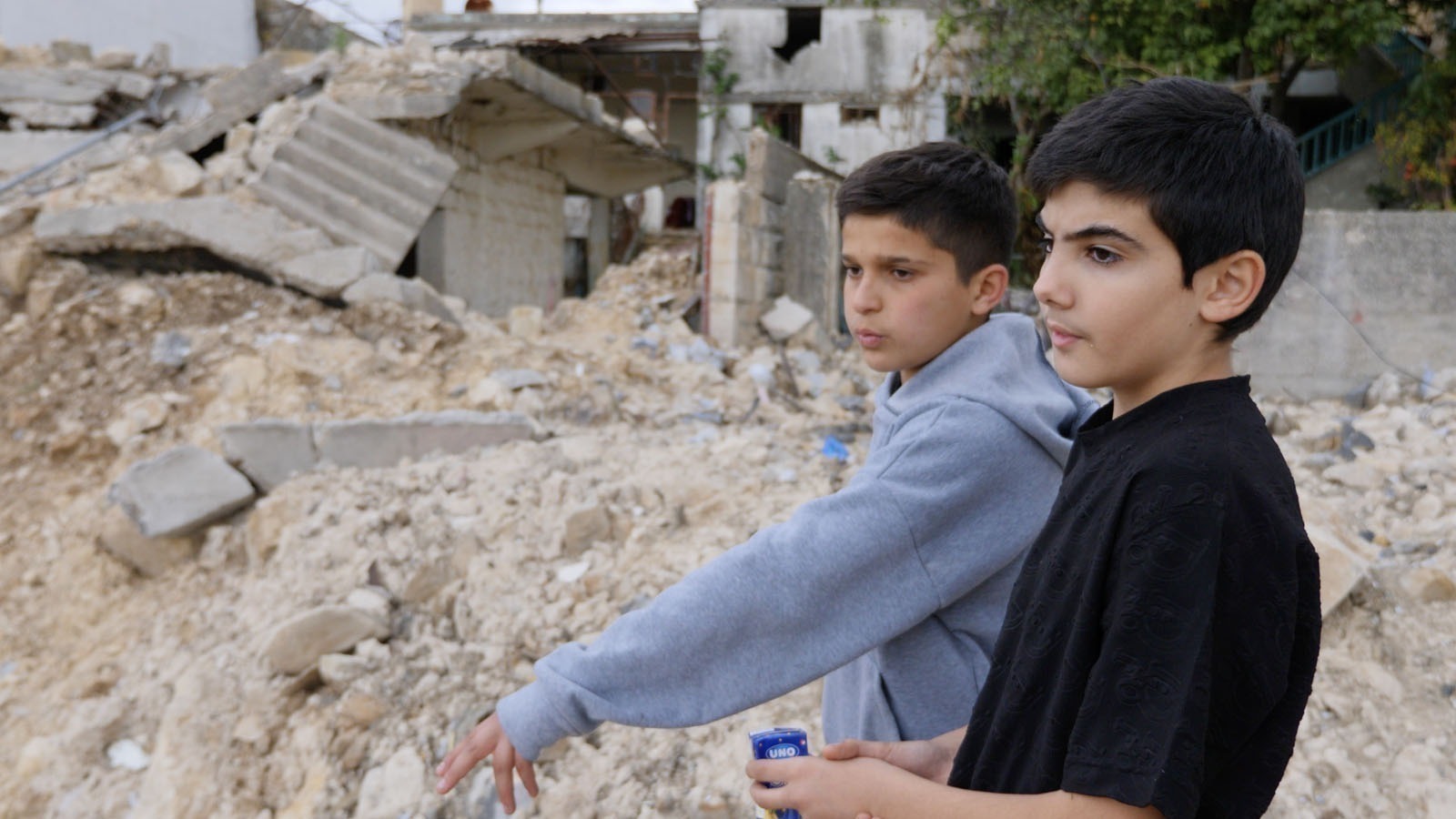
Iraqi French director Abbas Fahdel chronicles the war that devastated southern Lebanon in Tales of the Wounded Land, and Jean-Stéphane Bron’s six-episode series The Deal dramatizes the negotiations between the U.S. and Iran held in Switzerland in 2015. Eventually signed in Vienna, the agreement curtailed Iran’s nuclear program—until the U.S. backed out in 2018.
“We need to be able to ensure that the films we select will also tell, retrospectively, something to someone who will study what happened in Locarno while the world was in flames,” artistic director Giona A. Nazzaro tells Szalai. “I didn’t simply want the idea that even with the world going out of balance, we were just involved in our tiny cinephile squabbles. We wanted to have films, cinema, that look head-on into history.”
But of course not every film Nazzaro and his team have selected is aimed at a hot button. Radu Jude’s Dracula will surely take a jab or two at the current state of affairs in Romania, but Jude has also called his film “my love letter to Ed Wood.”
Last week, Locarno added Naomi Kawase’s Yakushima’s Illusion, starring Vicky Krieps, to the competition lineup, bringing the total number of films vying for the Golden Leopard—including new work from Fabrice Aragno, Abdellatif Kechiche, Alexandre Koberidze, Dane Komljen, Julian Radlmaier, and Ben Rivers—to eighteen. Rivers’s Mare’s Nest “shadows a young girl named Moon as she meanders through a world without adults,” writes Hynam Kendall at Club Ciné. “Not dystopia, but something quieter—stranger. Less a story than state of mind, it’s texture as plot: wind, silence, light shifting on skin.”
Locarno’s other competitions are the Concorso Cineasti del Presente, which spotlights first and second features, and the Pardi di domani, a showcase of “expressive experimentation and innovative forms of poetry.” Meanwhile, out on the Piazza Grande, there will be world premieres—Brian Kirk’s The Dead of Winter, starring Emma Thompson, for example, and Miguel Ángel Jiménez’s The Birthday Party with Willem Dafoe—and surefire crowd-pleasers such as Joachim Trier’s Sentimental Value and Stanley Kubrick’s The Shining (1980).
By the time In the Land of Arto screens long after sundown, this year’s retrospective, Great Expectations: British Postwar Cinema 1945–1960, will already be underway. Curated by Ehsan Khoshbakht, the program that aims to “tell the story of a nation in search of its identity” will have opened in the afternoon with Humphrey Jennings’s 1945 docudrama A Diary for Timothy, in which Michael Redgrave narrates a letter—written by E. M. Forster—to a baby born in September 1944. Locarno’s survey spans more than forty films and includes classics and rediscoveries from such directors as David Lean, Michael Powell, Carol Reed, Muriel Box, Joseph Losey, and Basil Dearden.
Histoire(s) du Cinéma, the sidebar dedicated to new restorations and films about films, will also open this afternoon. Henry King’s 1926 western The Winning of Barbara Worth features Gary Cooper in his first credited role, cinematography by a young Gregg Toland, and a score performed live by the Orchestra della Svizzera italiana. Further highlights of the program include Jean Vigo’s L’Atalante (1934), Liliana Cavani’s The Year of the Cannibals (1960), Roberto Rossellini’s Italy Year One (1974), Jackie Chan’s Project A (1983), Ang Lee’s Sense and Sensibility (1995), Carlos Reygadas’s Silent Light (2007), and Alexander Payne’s Nebraska (2013).
Don’t miss out on your Daily briefing! Subscribe to the RSS feed.