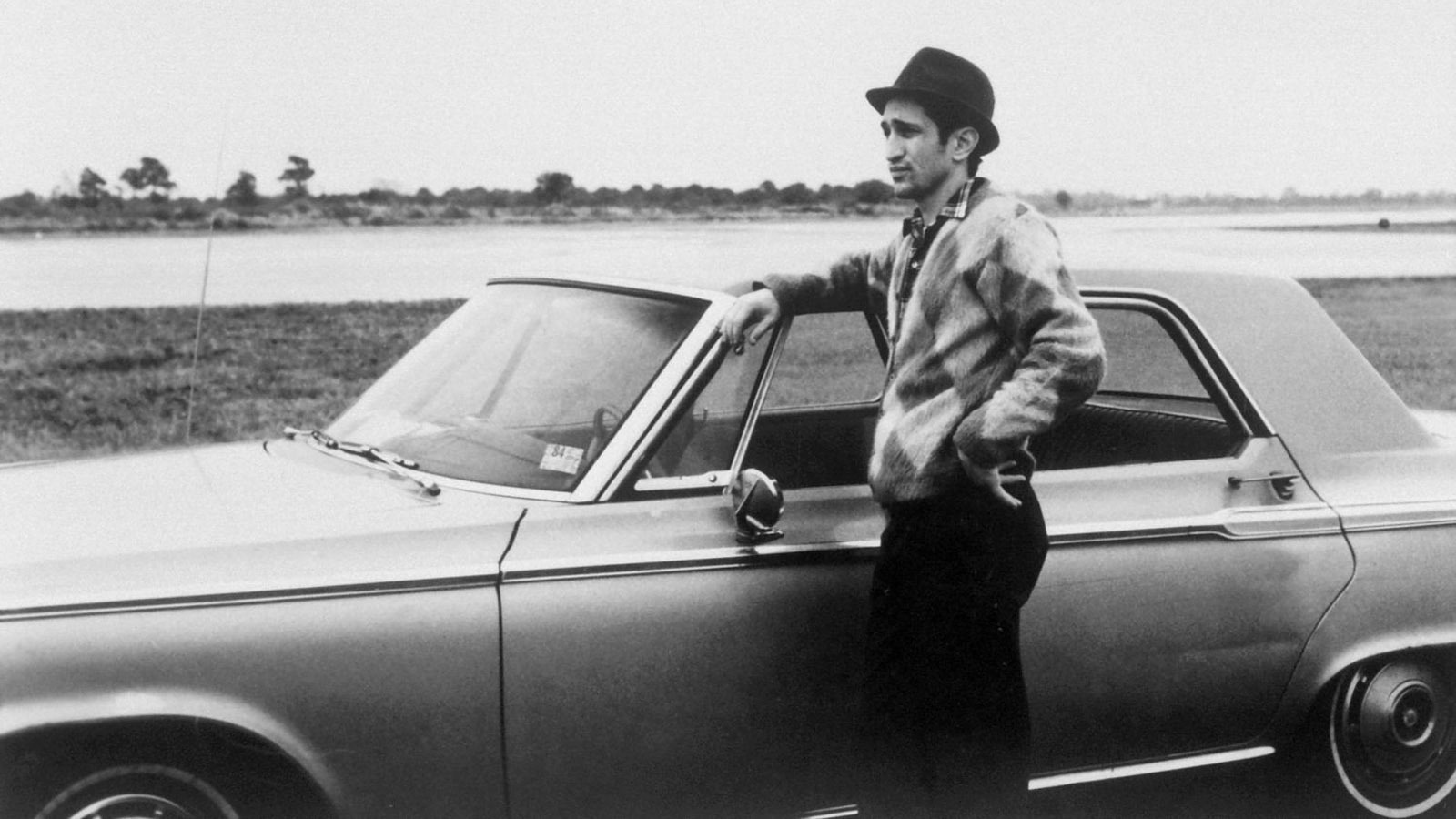
Richard Edson in Jim Jarmusch’s Stranger Than Paradise (1984)
George Cukor’s swanky pre-Code comedy Dinner at Eight (1933); Martin Ritt’s directorial debut, Edge of the City (1957), starring John Cassavetes and Sidney Poitier; Robert M. Young’s immigration drama ¡Alambrista! (1977); Susan Seidelman’s quintessentially 1980s New York story Desperately Seeking Susan (1985); John Sayles’s Matewan (1987), a riveting recounting of a coal miners’ strike in 1920; Tim Burton and Henry Selick’s beloved stop-motion animated musical The Nightmare Before Christmas (1993); Ang Lee’s rom-com The Wedding Banquet (1993), the winner of the Golden Bear in Berlin; Spike Lee’s lacerating satire Bamboozled (2000); and Gina Prince-Bythewood’s groundbreaking debut feature, Love & Basketball (2000), are among the twenty-five titles just added to the National Film Registry.
This year’s additions bring the total number of “culturally, historically, or aesthetically significant” films recommended for preservation to 875. Starting Thursday, the Academy Museum in Los Angeles will celebrate thirty-five years of the Registry with Works of Enduring Importance, a ten-film series opening with the presentation of a 70 mm print of Zoot Suit, the 1981 musical Luis Valdez (La Bamba) adapted from his Broadway play and featuring songs by the legendary Lalo Guerrero. Edward James Olmos narrates the story of a young barrio leader, Henry Reyna (Daniel Valdez, who wrote the film’s score). When Henry and his gang are falsely accused of murder, the trial in Los Angeles leads to the real-life Zoot Suit Riots of 1943.
The weekend brings Edgar G. Ulmer’s tight and nasty noir Detour (1945) and Barbara Connell and William C. Jersey’s Oscar-nominated A Time for Burning (1966), which documents a Lutheran minister’s attempts in Omaha to get his white congregation to reach out to the city’s Black communities. Just before Christmas, the Museum will screen 35 mm prints of Michael Schultz’s Cooley High (1975), which Craigh Barboza calls “not only a funny and intensely touching film about Black adolescents—a rarity for its time—but also one of the great coming-of-age movies,” and Haskell Wexler’s Medium Cool (1969), featuring Robert Forster as a television news cameraman caught up in the tumult of the 1968 Democratic National Convention in Chicago. For Thomas Beard,Medium Cool is “a film remarkable for its insistence that no one exists outside of politics, whether one experiences it as a backdrop to daily life (a wrinkled Bobby Kennedy poster in a cramped apartment) or as a nightstick to the gut.”
After the holiday break, the series returns with Gregory Nava’s El Norte (1983), which follows a brother and sister fleeing persecution in Guatemala and seeking refuge in the U.S. Nava “tells their story with astonishing visual beauty, with unashamed melodrama, with anger leavened by hope,” wrote Roger Ebert in 2004. El Norte is “a Grapes of Wrath for our time.” In 1990, Ebert found Reginald Hudlin’s House Party, starring Kid ’n Play, to be “silly and high-spirited and not particularly significant, and that is just as it should be.”
Last summer, Oliver Wang observed that when Wayne Wang’s Chan Is Missing was released in the spring of 1982, it “became the first narrative feature made ‘by and about’ Chinese/Asian Americans to gain widespread recognition and distribution—a genesis moment for an Asian American cinematic practice now into its fifth decade. Chan is more than just a first, however. Its enduring significance—and pleasures for the viewer—lie in how Wang distills a set of broad social themes through his intimate snapshot of San Francisco’s Chinatown neighborhood and its delightful panoply of personalities.”
“On one hand,” wrote J. Hoberman in 2007, Jim Jarmusch’s Stranger Than Paradise (1984) is “one of the purest expressions of a sensibility that developed in Lower Manhattan’s clubs and lofts during the late seventies and early eighties; on the other, Jarmusch’s movie belongs to a particular eighties tendency in which all manner of immigrants, extraterrestrials, mermaids, time travelers, and suburban-born SoHo artists—in a word, aliens—dropped in on America and, like our Hollywood President, served to validate it for us. But where the previous year’s independent blockbuster Liquid Sky, made by an inspired gang of Russian émigrés, shed an authentically alien perspective on the same milieu, Stranger Than Paradise was unaccountably sweet.”
The Museum’s series wraps on January 27 with a thirtieth anniversary screening of Steve James, Frederick Marx, and Peter Gilbert’s landmark documentary, Hoop Dreams (1994). “There isn’t a better argument for the social value of long-form nonfiction filmmaking than Hoop Dreams,” wrote director Robert Greene (Kate Plays Christine, Procession) in 2015. “And sports have never been put into such careful context, where the dramatic power of winning and losing is woven into the narrative construction of characters’ lives rather than overwhelming it. Hitting a last-second layup matters, but only because these boys’ dreams register as meaningful, intricate, and real. There’s a reason Roger Ebert called it ‘the great American documentary.’”
Don’t miss out on your Daily briefing! Subscribe to the RSS feed.
This month’s roundup spotlights new titles on Murnau, Welles, Capra, Zulawski, and Richard Fleischer as well as forthcoming books from Matías Piñeiro and Tilda Swinton.