Legend holds that hip-hop was born on August 11, 1973, when Jamaican American Clive Campbell, a.k.a. DJ Kool Herc, threw an extra kick into a Bronx dance party by spinning two copies of the same record on two turntables and switching from one thumping instrumental break to the next. Over time, he began rapping over the elongated string of beats. “That is, of course, one way to think about hip-hop’s big-bang moment, but by no means the only one,” writes Jon Caramanica in his introduction to a package in the New York Times gathering fifty oral mini-histories from fifty rappers to commemorate the fiftieth anniversary of a musical genre that has been “a continuation of rock, soul, and jazz traditions, while also explicitly loosening their cultural grip.”
For Caramanica, the point is that, whatever story is told about its origins, “for decades, hip-hop was perceived as disposable, a nuisance, an aberration. Commemoration and enshrinement seemed far-fetched. For a long time, hip-hop had to argue for its rightful place in pop music, and pop culture, facing hostilities that were racial, legal, musical, and beyond.” But “hip-hop was never going anywhere, because no style of pop music has been as adaptive and as sly.”
From Friday through October 21, New York’s Museum of the Moving Image will present Real Rap: Hip-Hop Star Power on Screen, and on August 1, we’ll be launching our own celebration on the Criterion Channel with a program of eighteen films. The overlap between the two selections is thin—just two titles, Poetic Justice (1993) and Belly (1998)—which could be read as a testament to the multifaceted reach of hip-hop onto disparate screens. Poetic Justice, John Singleton’s follow-up to his explosive debut, Boyz n the Hood (1991), “wasn’t the lightning rod that Boyz was, but it deserves equal consideration,” argued Mark D. Cunningham in the Atlantic when Singleton passed away in 2019.
In his remembrance of Singleton for RogerEbert.com, Odie Henderson pointed out that Poetic Justice “was like very few other Black films before it, a standard issue road trip movie that existed in a refreshingly lackadaisical, plotless, and character-driven ether; it meandered like Eric Rohmer and swore like Richard Pryor. The movie made viewers flies on the windshield of [Tupac Shakur’s] post office truck, looking in on him and Janet Jackson as they navigated the prickliest of near-romances.”
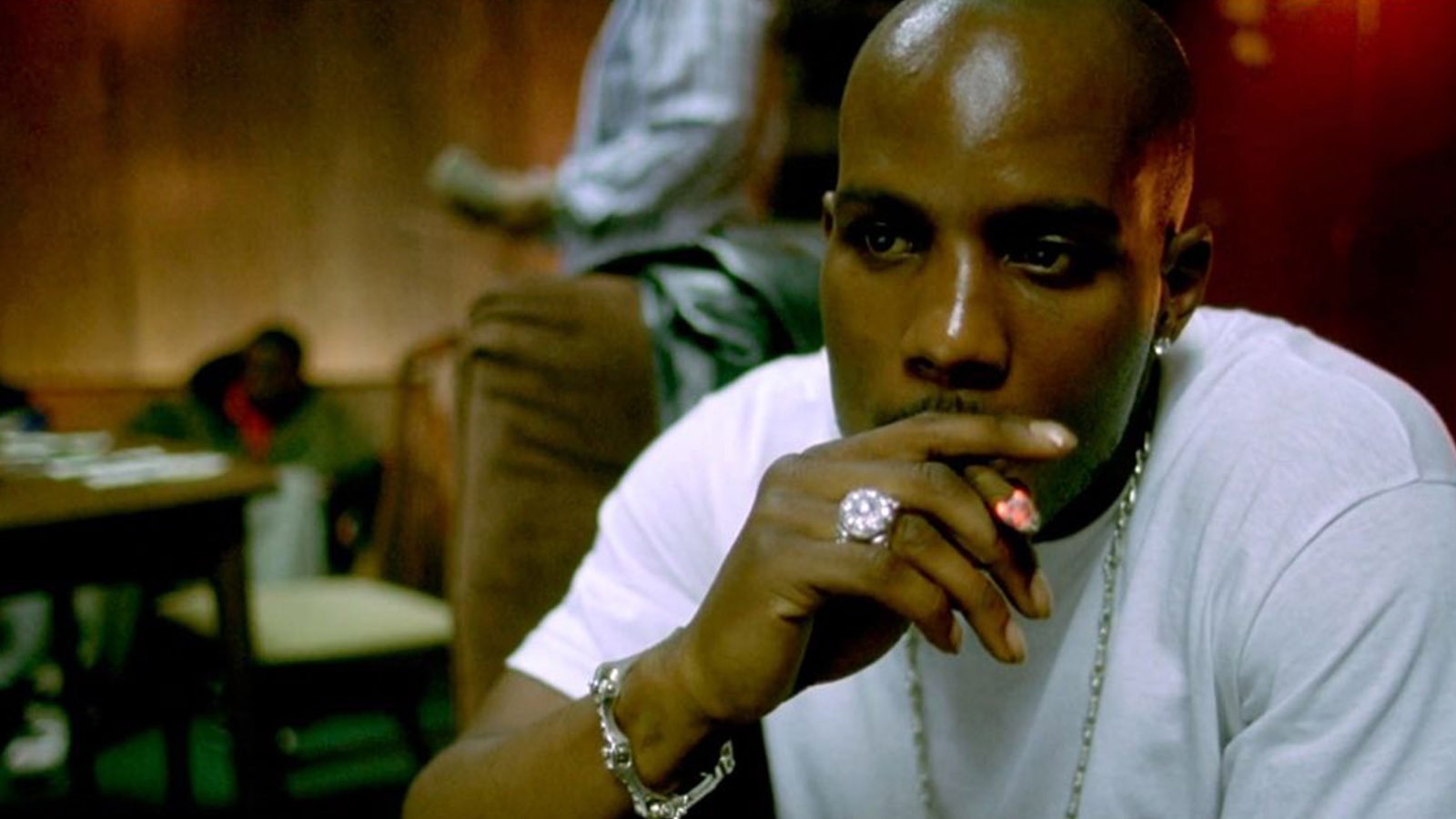
Belly, which stars Nas and DMX and is still the only feature from accomplished music video director Hype Williams, bombed at the box office and was torn apart by critics. Its cult following, though, has been quietly swelling ever since. “Belly is mana for both ’90s-fetishizing rap nerds (raises hand) and fans of ambitious, hallucinatory genre fare (raises other hand),” wrote Clayton Purdom at the A.V. Club in 2018. “Alternating voice-overs, freeze-frames, split-screens, slow-motion, delirious floods of red and blue and luminous black light—all are fair game.” Williams “captures barbershops and New York basketball courts and Jamaican dance halls with a grainy authenticity, but pairs them with surrealist detours unlike anything in the post-Tarantino crime-caper boom.”
MOMI’s program of twelve features opens with Mario Van Peebles’s debut feature, New Jack City (1991), which pits an undercover cop (Ice-T) against a drug lord (Wesley Snipes). In 2007, the Chicago Reader’s J. R. Jones noted that while the film “often plays like a ’70s cop show, it became a prototype for the bling-heavy gangsta melodramas of the ’90s.” Before wrapping the series with John Carpenter’s intentionally OTT space western Ghosts of Mars (2001), featuring Ice Cube and Pam Grier, the Museum will present a movie Ice Cube actually enjoyed making, Tim Story’s endearing comedy, Barbershop (2002).
Real Rap also features Reginald Hudlin’s hit comedy House Party (1990), starring Kid ’n Play and launching an enduring franchise; Oliver Stone’s Any Given Sunday (1999), with its soundtrack featuring OutKast, Mobb Deep, and DMX; John Singleton’s 2001 drama Baby Boy, with Tyrese Gibson, Taraji P. Henson, Ving Rhames, and Snoop Dogg; Curtis Hanson’s well-received Eminem vehicle, 8 Mile (2002); and Sanaa Hamri’s Just Wright (2010), a love story starring Queen Latifah and Common.
The programmers have also set up two eventful weekends. On August 19, the screening of Bryan Barber’s Depression-era OutKast musical Idlewild (2006) will be followed by a summer dance party featuring DJ Wiz of Kid ‘n Play, DJ Ultra Violet, and Bossman. On October 14, Andrew Chan, author of the forthcoming Why Mariah Carey Matters, will introduce Bill Duke’s Sister Act 2: Back in the Habit (1993), featuring Lauryn Hill’s performance of “His Eye Is on the Sparrow.” The following day, a Sunday, is Family Day, a full afternoon of activities including karaoke featuring songs from Sister Act 2.
Subscribe to the RSS feed, and for news and items of interest throughout the day, every day, follow @CriterionDaily.
This month’s roundup spotlights new titles on Murnau, Welles, Capra, Zulawski, and Richard Fleischer as well as forthcoming books from Matías Piñeiro and Tilda Swinton.