Alphaville
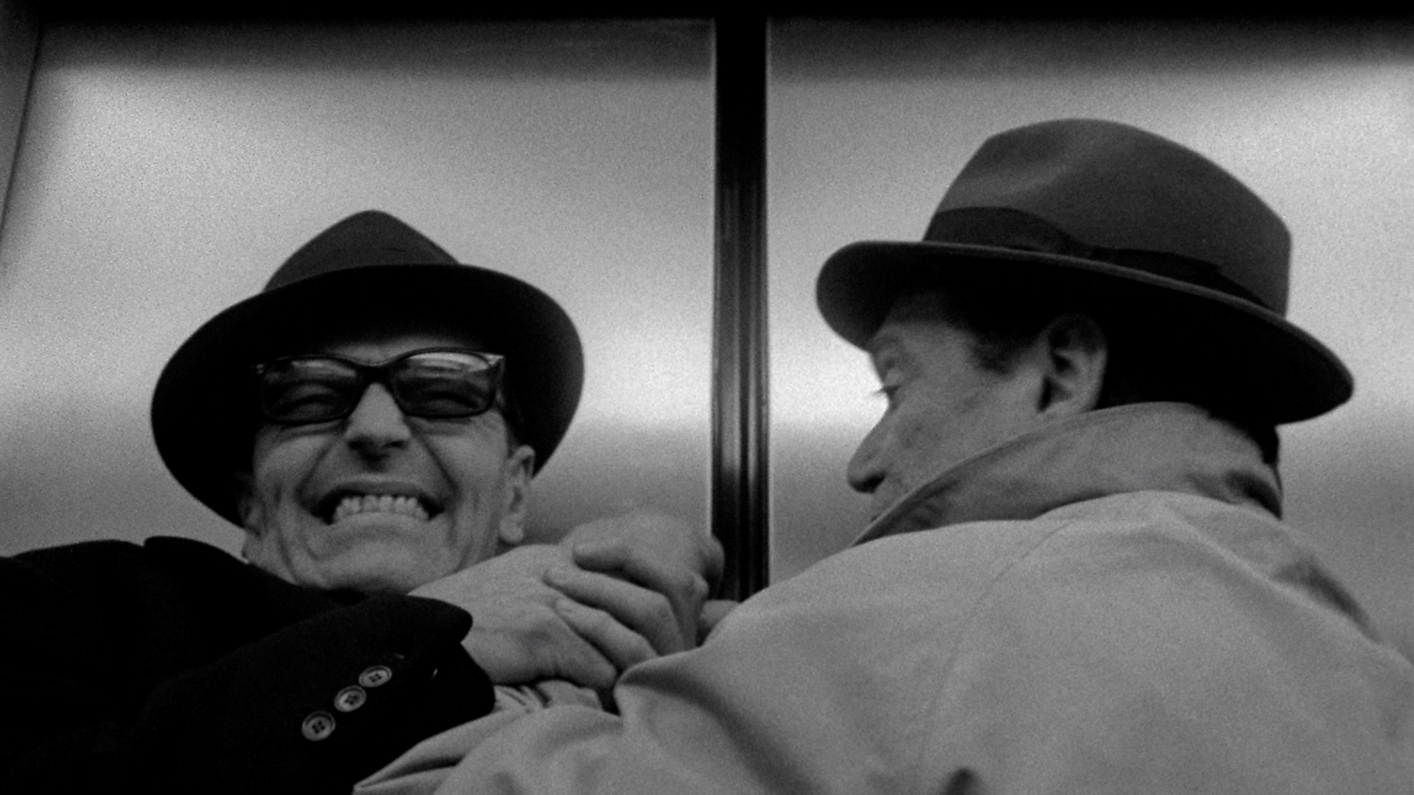
When Jean-Luc Godard’s Alphaville opened the 1965 New York Film Festival, the American Civil Liberties Union Benefit audience seemed genuinely baffled by the abrupt shifts in tone: from satirically tongue-in-cheek futurism, to a parody of private-eye mannerisms, to a wildly romantic allegory depicting a computer-controlled society at war with artists, thinkers, and lovers.
Alphaville is science fiction without special effects. Godard couldn’t afford them in 1965 or ever, but he probably wouldn’t have wanted them even if he’d had unlimited financing. His whole theme, imagination versus logic, is consistent with his deployment of Paris as it was in the ’60s—or at least, those portions of Paris which struck Godard as architectural nightmares of impersonality. Sub-Nabokovian jokes on brand names abound. There is much talk of societies in other galaxies, but their only manifestation is the Ford Galaxy that Eddie Constantine’s Lemmy Caution (a low-rent French version of Sam Spade and Philip Marlowe) moves about in. Most of Alphaville is nocturnal or claustrophobically indoors. Yet there is an exhilarating release in many of the images and camera movements because of Godard’s uncanny ability to evoke privileged moments from many movies of the past.
Alphaville was never meant to shock, depress, or disgust, and thus it seems as decorous and decent in 1998 as it did in 1965. And it is the work of one man, one recognizable man, not the work of a cynical, calculating committee. Indeed, the computer-controlled villains in Alphaville bear more than a passing resemblance to the bottom-line driven villains in the motion picture industry. To understand and appreciate Alphaville is to understand Godard, and vice versa. The shapely girl swimmers with knives for teeth and shark-like instincts for souls are an expanded version of Alexandra Stewart’s bikini-clad shark in the Godard episode of RoGoPag, the episode Lincoln Center audiences hissed violently in 1963. Also from RoGoPag are the pills the population of Alphaville gobbles up like peanuts to retain tranquility in the absence of recollection.
The Welles influence, particularly from Mr. Arkadin, is reflected in the free-wheeling performance of Akim Tamiroff amid the swinging light bulbs of Wellesian expressionism. The references to Dick Tracy and Flash Gordon are pure comic-strip pop, and the reference to relativity and the SS pure comic angst.
Godard, the celebrated enfant terrible of the nouvelle vague, shamelessly parades Anna Karina, the greatest love of his life among his several Galateas (Jean Seberg in Breathless had been one of the first). Karina plays Natasha Vonbraun, the daughter of Professor Vonbraun (the whimsical fusion of a Tolstoyan first name and a Nazi rocket-scientist last name is typical of Godard’s irreverent plague-on-both-your-houses attitude toward the Cold War). This love of Karina is on display with Godard’s love of movies. Cameo appearances by Jean-André Fieschi, as Professor Eckel, and Jean-Louis Commoli, as Jeckel, represent a combination of two of Godard’s successors on the staff of Cahiers du Cinéma with two Hollywood animated cartoon figures.
One may quibble over the fallacy of expressive form in illustrating computer control through the rasping-gurgling sounds of a man who has lost his voice box. Technological totalitarianism could certainly have come up with a morebeguiling tone with which to seduce its subjects. Nonetheless, I am more moved today than I was in 1965 by Godard’s temerity in having Karina sum up the moral of the film with a deliberately intoned reading of the line, “Je vous aime.”
There is a moment of weary acceptance in Alphaville when Eddie Constantine, his face fading into the shadows, acknowledges that it is fate to become a legend. It is an image of intellectual heroism and self-recognition such as I have seldom seen on the screen. And in one flash, Godard illuminates one of Constantine’s most memorable responses to one of the computer’s questions in an earlier sequence. “What transforms darkness into light?” Constantine is asked. “La poèsie,” he replies. That a semi-hoodlum should be capable of such articulated sensitivity seems unlikely, but no more unlikely really than the ability to join comic strips and love sonnets with a single sensibility.
You don’t have to be French to enjoy Alphaville. But you have to love movies with high-minded seriousness.

More: Essays

Christiane F.: Up Against the Wall
Uli Edel’s harrowing tale of youth rebellion is one of cinema’s greatest Berlin films, a visceral urban portrait that captures the city’s doom and decadence during the Cold War era.

The Shout: Sound and Fury
Blending elements of psychological thriller, social satire, and psychedelic film, Jerzy Skolimowski’s Cannes-award-winning classic uses its audacious sound design to evoke the terror of English civilization.

Welcome II the Terrordome: The Future Is Furious
A dystopian drama that draws on the influences of African mythology and hip-hop, Ngozi Onwurah’s debut feature uses a mix of speculative forms to expose anti-Blackness as a system that underpins the modern world.
Days and Nights in the Forest: Into the Woods
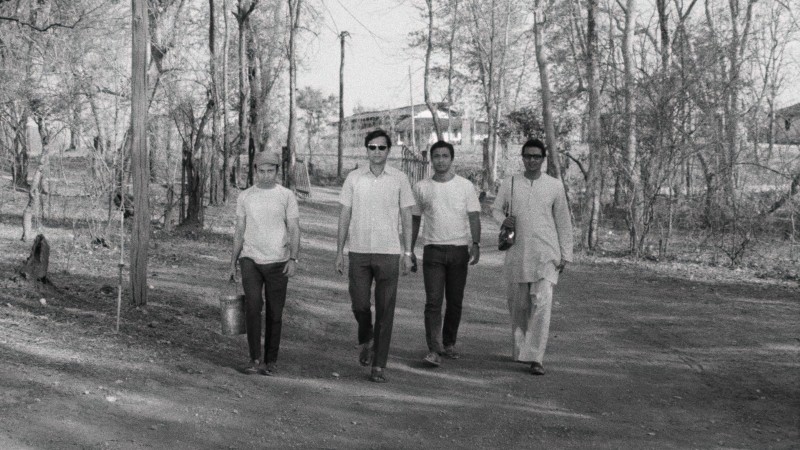
In this tale of four privileged bachelors who embark on a trip to the Indian countryside, Satyajit Ray balances a biting critique of masculine fragility with splendid visual grace.