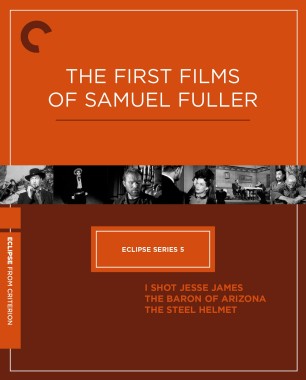
The First Films of Samuel Fuller: Baptism by Fire
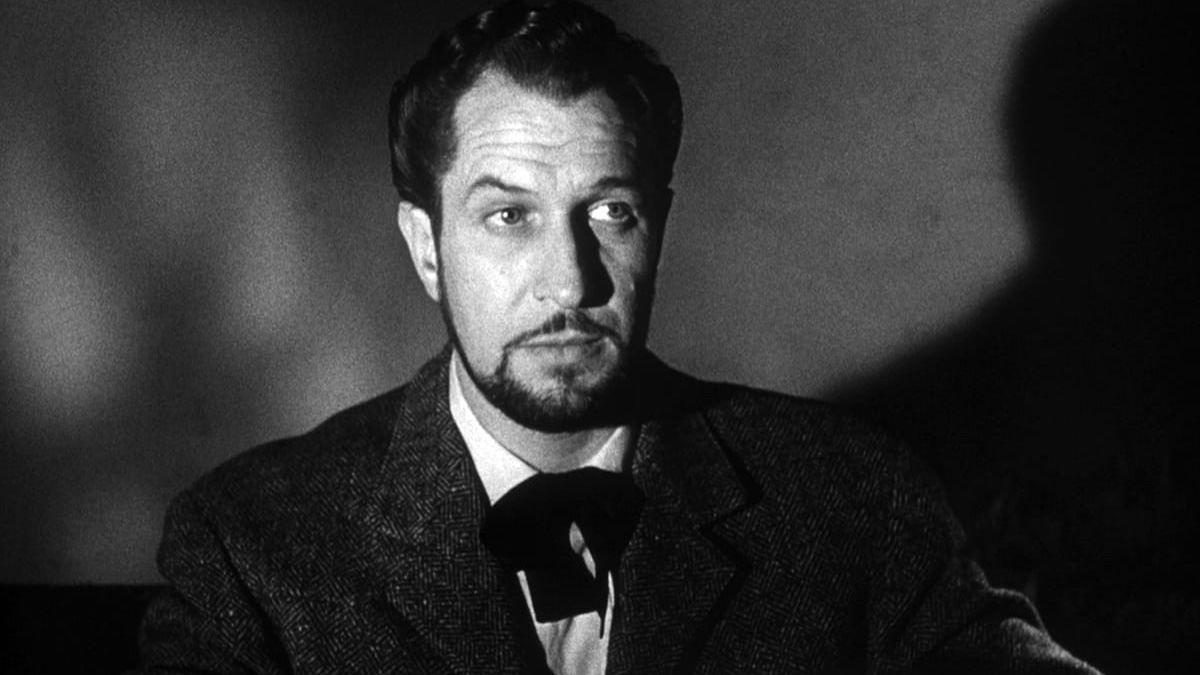
Instead of calling “Action!” Samuel Fuller discharged a Colt .45 in the air. It was the first take of the first day’s shooting on his first feature as a director, I Shot Jesse James (1949), and Fuller knew the importance of a punchy opening—“If a story doesn’t give you a hard-on in the first couple of scenes, throw it in the goddamn garbage,” he would later opine. Ever the hambone performer, Fuller was constructing his own warrior-filmmaker legend from the get-go.
Fuller knew his way around firearms from his basic-training days, and his combat experience would heavily color his career as a writer-director, which he began at the seasoned age of thirty-six, when he’d already lived several lives. Born in 1912 in Worcester, Massachusetts, and transplanted to Manhattan’s Washington Heights neighborhood shortly after his father’s death in 1923, Fuller left high school at seventeen to cover the crime beat for Bernarr Macfadden’s tawdry tabloid the New York Evening Graphic. He then wandered Depression-era America as a freelance reporter and pounded out pulp novels, and by the time he answered the summons of World War II, he had a clutch of screenwriting and story credits under his belt. Decorated and demobbed after seeing action in North Africa, Sicily, and Normandy, Corporal Fuller returned home to his typewriter and to shopping scripts around Hollywood. He was contacted by independent producer Robert L. Lippert, who’d admired Fuller’s 1944 book The Dark Page, and was interested in soliciting his services as a screenwriter. Fuller wrangled permission to direct his own scripts from Lippert, whose operation was not exactly awash in A-list above-the-line talent. What was the worst that could happen?
Lippert, three years older than Fuller, had spent his life in the movie business: after building up a chain of West Coast theaters, starting in his hometown of Alameda, California, Lippert had ventured into producing films in 1945, first under the auspices of Action Pictures, then of Screen Guild Productions, and then, by the time Fuller entered his orbit, of Lippert Pictures, whose imprimatur graced scores of bargain-bin westerns filmed at Simi Valley’s Corriganville Movie Ranch or any other location that could be secured on the cheap for six or seven shooting days.
Fuller’s first three films, all made for Lippert, would be his baptism by fire and proving ground: the budgets were minuscule and the schedules punishing, but as long as he kept an eye on the bottom line he was given a great deal of freedom. By virtue of the breakneck pace at which Lippert churned out films, if nothing else, his low-oversight operation allowed for the kind of snapping-live-wire moviemaking that Fuller reveled in and would build his reputation on: rude political and racial provocations; sucker-punch cuts to close-up; jarring camera moves; willfully grotesque characterizations; surreally lurid dialogue—in short, the sort of unruly stuff that the more mindful (and plentiful) overseers at major studios would have punctiliously rooted out when reviewing the dailies.
I Shot Jesse James: Trigger Effect
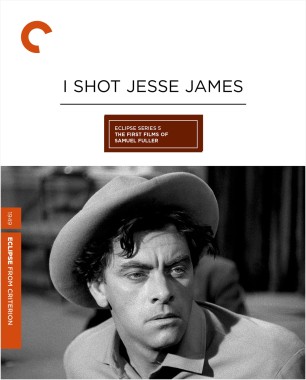
It cannot be said that, as of the late 1940s, American cinema had neglected the story of the James-Younger Gang, the notorious bushwhackers-turned-outlaws who rode out of Missouri during and immediately after the Civil War. But Samuel Fuller’s I Shot Jesse James stands apart from its already multitudinous forebears by virtue of its focus on Robert Ford, onetime right-hand man to the late, lamented Jesse, the same Ford who’d earned American boyhood’s eternal enmity and been immortalized in song as a “dirty little coward” after shooting the folk-hero brigand from behind. As played by John Ireland, whose performance in Howard Hawks’s Red River (1948) Fuller had admired, Ford is a slow-witted if hardly nefarious character, nursing a broken heart in the wake of the fateful shot, which he fired for a ten-thousand-dollar reward and a chance to win the hand of Cynthy (Barbara Britton), an actress he’d become enamored of. Marinating in self-loathing after pulling the trigger, Ford will become something of a thespian himself, sentenced to relive the moment that defined him in the public eye when he takes a gig going town to town to reenact an assassination already engraved in the annals of frontier lore.
Approaching familiar material from an unusual, canted perspective, Fuller’s film anticipates the rise of the brooding “psychological” western while indulging in none of the portentousness of, say, Fred Zinnemann’s High Noon (1952). The dominant tone of I Shot Jesse James is one of smothering anxiety, with a sweat-streaked Ireland squirming under the scrutiny of Fuller’s close-ups. One suspects that part of what drew the director to his leading man was the at times flirtatious rapport between Ireland and Montgomery Clift in Hawks’s film, since the interplay between James and Ford here, particularly in an eyebrow-raising bathtub scene, has an intimacy and intensity suggesting something more than mere partnership in a criminal enterprise. As in his 1955 House of Bamboo, in which henchman Cameron Mitchell pitches a hysterical, possessive outburst over losing the favor of criminal kingpin Robert Ryan, or his 1957 Forty Guns, which finds cattle queen Barbara Stanwyck riding herd alongside a harem of twoscore hired cowhands, Fuller in his first film relishes suggesting the sublimated sexuality that undergirds a culture of violence, and Ford’s dorsal ambush appears as much a matter of quashing his desire for Jesse as of fulfilling any he has for Cynthy. All of which may very well have been lost on Lippert, who Fuller claimed was “too uptight to even pronounce the word homosexual.”
The Baron of Arizona: This Land Is My Land
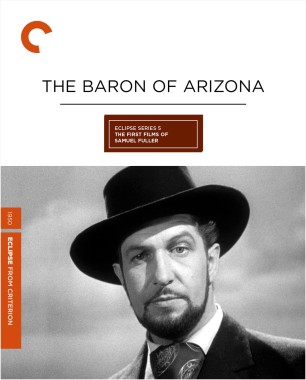
Samuel Fuller’s second project for Lippert Pictures, The Baron of Arizona (1950), offers another off-kilter perspective on American history, enlarging on a nigh-forgotten footnote in the settling of the Southwest. While working as an itinerant reporter, Fuller had first heard the story of flimflam artist “Baron” James Addison Reavis, who, after fighting for both sides in the Civil War and holding a variety of odd jobs, real-estate agent among them, arrived in the Arizona Territory in 1880, there to attempt perhaps the most ambitious land-claim swindle in history. Supported by reams of falsified documentation, Reavis endeavored to prove himself the rightful inheritor and beneficiary of a royal decree from Spain’s King Ferdinand VI that would give him reign over the entirety of Arizona; if his documents were validated, Reavis would be established as aristocracy, the territory as his fiefdom, and the current population as trespassers on private property.
In spite of its meager budget, The Baron of Arizona benefited from a fortuitous confluence of talent. James Wong Howe, one of the most versatile and ingenious cinematographers of his generation, agreed to shoot the film for a fraction of his normal fee, bringing a somber chiaroscuro to a frontier backdrop more often mined for big-sky monumentality. As such, this moody and at times downright decorous film can feel uncharacteristic of Fuller; those looking for rattling coup de caméra moments will be disappointed, though roiling sequences of mob violence among incensed salt-of-the-earth Arizonans do provide a note of Fullerian frenzy. And Fuller’s readiness to prod at uncomfortable matters concerning the subject of race in America—or, if you like, the subject races of America—emerges here as Fuller slyly hints that Reavis’s attempted land grab is anything but an anomaly in U.S. history. As settlers rally to decry the barony—“My father was the first white American to pitch a tent in Phoenix!” cries one—take note of the disenfranchised Native Americans dotting the crowd.
Another budget acquisition here is Vincent Price, who by 1950 had been knocking around Hollywood for more than a decade without ever quite breaking into the leading-man ranks. Released to middling reviews and box office, The Baron of Arizona didn’t provide him with the star-making part that he found three years later in André de Toth’s House of Wax, but Reavis remained among the actor’s favorite roles, a showcase for qualities that would eventually define Price in the popular imagination: his plummy, purring line readings; his lip-smacking delectation of all things devious; his general air of naughty overgrown boy caught emptying out the sugar bowl. Actor and director by all accounts got on swimmingly, with Price appreciating Fuller as only one scenery-chewer can appreciate another, recalling him as “a very flamboyant character [with] puttees and a megaphone and everything.”
The real-life Reavis didn’t end up in such happy circumstances as his fictionalized counterpart, who loses his territory but wins the love of an unwitting accomplice in his charade, played by Ellen Drew, yet Fuller maintained, “In the movie business, a good ending must sometimes hold sway over the truth.” The real reason, one suspects, is that Fuller was much too fond of this swanning mountebank to subject him to any harsher punishment.
The Steel Helmet: Battle Cry
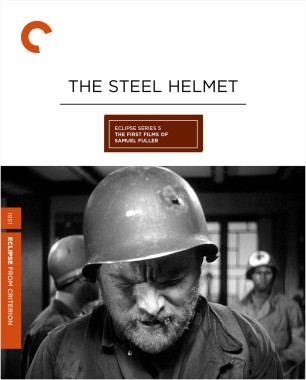
Samuel Fuller wasted no time in distinguishing himself from the median range of Poverty Row clock-punchers, but his third and final film for Lippert Pictures was an achievement of another order, a genuine hit and an honest-to-goodness calling-card movie. The circumstances of the shoot were no more propitious than those of his previous two features: a dispatch from the front lines of the Korean War, The Steel Helmet (1951) was to be shot on a ten-day schedule, with exteriors filmed on the slopes of Los Angeles’s Griffith Park, for a paltry one hundred thousand dollars. The lead role, that of a sorehead, battle-tested sergeant who’s the lone survivor of a decimated unit, went to Gene Evans, a burly bit player with a mean, myopic squint; his gruff Sergeant Zack would be piquantly described by Manny Farber as “like someone born on Torment Street between Malicious and Crude.” A World War II veteran, Evans impressed Fuller in their first meeting by instinctively catching and racking an M1 carbine that the director abruptly tossed his way. (A major studio had apparently shown interest in the script but wanted John Wayne as Zack—an idea, Fuller later wrote, that he promptly nixed.)
Soldiers stuck behind enemy lines on a foreign battlefield was by no means a novel premise—John Ford’s The Lost Patrol (1934) may have been a point of reference here—but Fuller’s still-fresh combat experience and Evans’s earthbound, lumpen presence lent The Steel Helmet an exceptional veracity. One incident is ripped straight out of Fuller’s war diary: a green soldier is vaporized by an explosive booby trap while trying to retrieve a dead GI’s dog tags. From the opening scene, in which Zack, wrists and legs bound, tortuously wriggles after the camera on his belly, the film displays a heightened attention to the sheer hump-busting physicality of war.
Since Harry S. Truman had signed Executive Order 9981 in 1948, the Korean War became the first conflict to be fought by a desegregated American military, and something of this reality is reflected in Fuller’s film. The patchwork patrol that assembles around Zack will include a Black medic, Corporal Thompson; a Japanese American grunt, “Buddha-Head” Tanaka; and a Korean orphan nicknamed Short Round. (The last sobriquet would be pinched by Fuller enthusiast Steven Spielberg for 1984’s Indiana Jones and the Temple of Doom.) For Fuller, a product of the multicultural scrum of New York City, this unlikely band of brothers was a microcosm of the American experiment, though no one could accuse this most egalitarian of filmmakers of political correctness: “Eat rice!” Zack barks when commanding Short Round to hit the deck. And so, with its racial jibes, its shocking eruptions of violence, its lump-in-throat sentimentality, and a few frankly bizarre subplots (will Baldy’s hair grow?), The Steel Helmet is nothing if not a testament to the anything-goes spirit of independent production.
Fuller hadn’t lost his newspaperman’s instinct for a scoop. The Steel Helmet was released on February 2, 1951, only half a year after fighting began between United States and North Korean forces, making it the first American fiction feature to address that conflict. (It was also among the first to broach the subject of the U.S. government’s internment of Japanese Americans during World War II.) The film was a massive success, so much so that the FBI was inspired to ask questions about Fuller’s political sympathies. But the director’s gonzo brand of patriotism couldn’t be questioned, and not only did the film make him, for a moment, a wealthy man, it also attracted the attention of Darryl F. Zanuck at Twentieth Century-Fox, who recruited Fuller to the big leagues (Robert L. Lippert would go to Fox himself in 1956). He was on his way up in the world, but, thankfully, this most pugnacious of filmmakers would never simmer down.
More: Essays
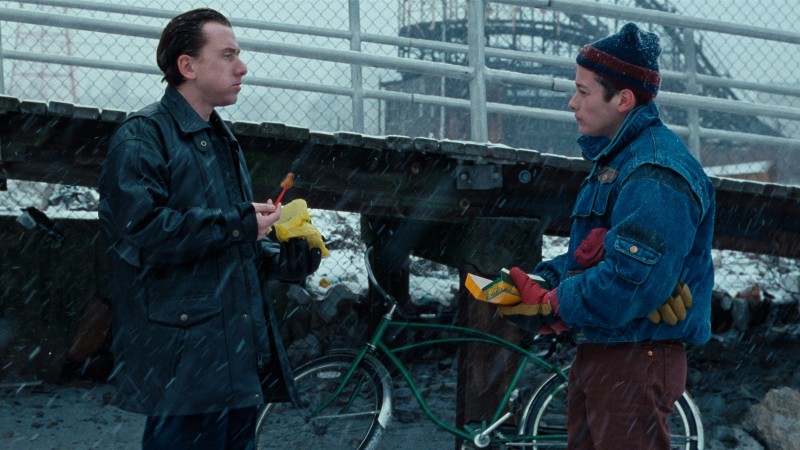
Little Odessa: He Ain’t Heavy, He’s My Brother
James Gray’s extraordinary debut feature is a painstakingly distilled tale of crime and family dysfunction, captured with a merciless gaze and a sharp attention to idiosyncratic detail.
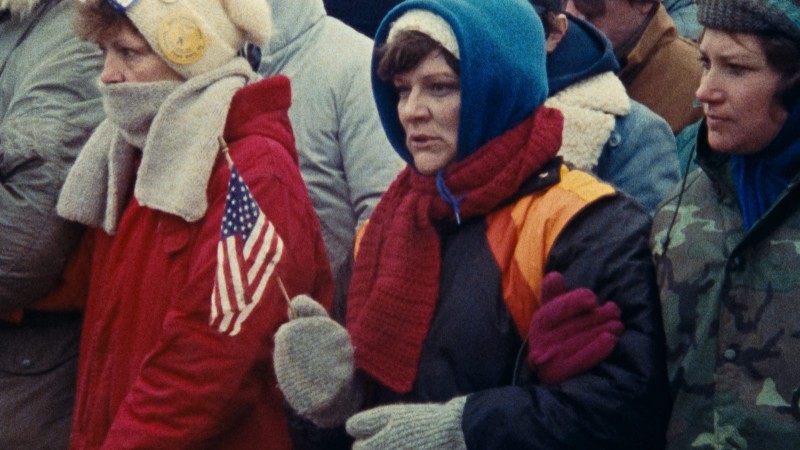
American Dream: The Time Is Right
In her second film, Oscar-winning documentarian Barbara Kopple captures the anguish and perils of disunity in the labor movement and the corrosion of union power during the Reagan era.
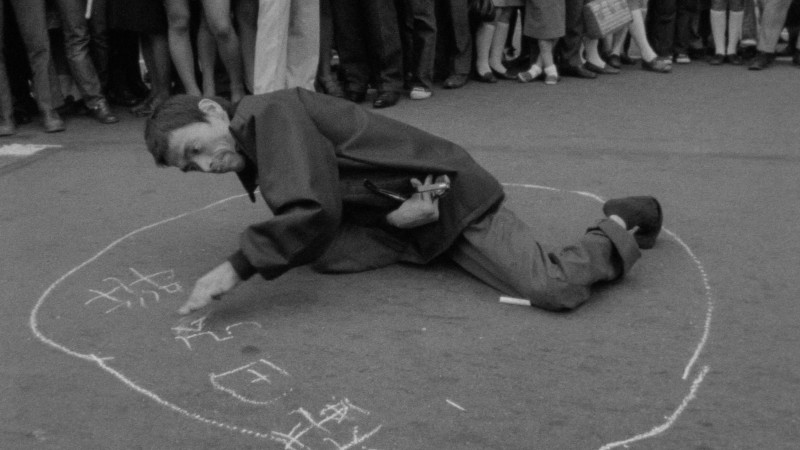
Five Radical Documentaries by Kazuo Hara and Sachiko Kobayashi: Restlessness Refusing Resolution
The pioneering husband-and-wife duo transformed the field of Japanese nonfiction cinema with their portraits of spectacular, edgy personalities and collectives under duress.
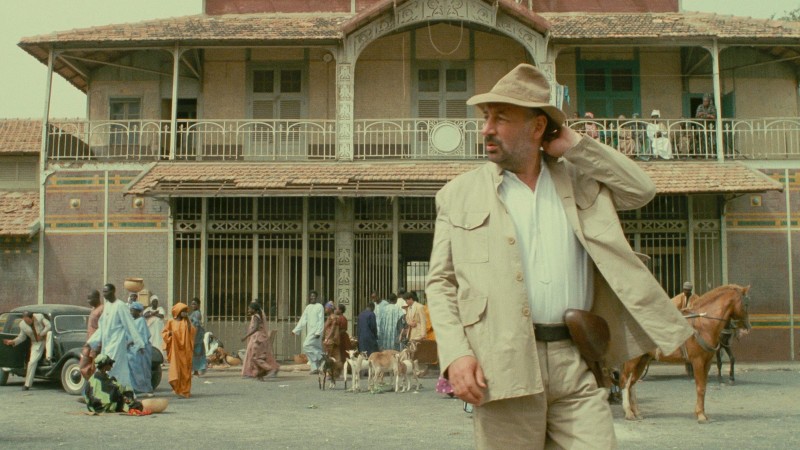
Coup de torchon: “All Crimes Are Collective”
Set in 1930s French West Africa, Bertrand Tavernier’s hard-to-classify adaptation of the Jim Thompson novel Pop. 1280 offers an apocalyptic vision of a society in which institutions have abdicated their moral authority.