All That Heaven Allows: An Articulate Screen

Douglas Sirk once said: “This is the dialectic—there is a very short distance between high art and trash, and trash that contains an element of craziness is by this very quality nearer to art.” When All That Heaven Allows was released by Universal Pictures in 1955, it was just another critically unnoticed Hollywood genre product, designed to appeal to the trashy “women’s weepie” audience. Now, in retrospect, it is considered to be closer to the art side of Sirk’s dialectic, and one of his key films. But this is part of a wider process of critical reevaluation in which his entire body of work has been rediscovered and reappraised by successive generations of filmmakers and historians.
No one seeing the film at the time of its release would have imagined its director to be an elegant, extremely erudite European whose career started in the theater of Weimar Germany and who was an early director of Bertolt Brecht’s The Threepenny Opera. After a short but successful career at UFA studios in the vacuum left by the massive emigration of Jewish talent after the Nazis came to power in 1933, Sirk made his way to Hollywood, directing his first film there in 1942. Following an unsuccessful attempt to return to Germany in 1949–50, he signed a contract with Universal. His movie career then culminated with his highest-profile films, the melodramas of 1952–58. By 1959, he was Universal’s most successful director. At that very moment, he left moviemaking and America. Until his death in 1987, he and his wife, Hilde, lived in Lugano, Switzerland.
All That Heaven Allows marks the final turning point in Sirk’s strange and varied career. On the back of Magnificent Obsession’s success the previous year, Universal gave him a budget and freedom that enabled his mature style to blossom. All That Heaven Allows contains all the elements of characteristically Sirkian composition: light, shade, color, and camera angles combine with his trademark use of mirrors to break up the surface of the screen. Here are all the components of the “melodramatic” style on which Sirk’s critical reputation is based and that has made him the favorite of later generations of filmmakers, from Rainer Werner Fassbinder to Quentin Tarantino, from John Waters to Pedro Almodóvar.
But at the time, Universal was just anxious to repeat its successful pairing of Jane Wyman and Rock Hudson in a romance between an older woman and an extremely handsome younger man. Wyman was still a big star but, by then, past her prime. Recently divorced from Ronald Reagan, and aware that her future lay with the soap-opera audience, she was pleased to be teamed with Hudson again. At the time, he was the new Hollywood heartthrob, who, although “out of the closet” in his personal life, had to be continually shut back in publicly and professionally by an anxious studio.
The All That Heaven Allows version of the May-September romance formula has Wyman playing Cary Scott, a well-to-do widow with two college-age children and a dull social life at the country club. The emptiness at the heart of her existence is filled when she meets Ron Kirby, the young gardener–turned–tree farmer who prunes the trees that line her all-American suburban yard—and then comes back to court her. This simple love story is disrupted by the vicious snobbery of her children and high-society acquaintances. Early in the film, Cary is at her dressing table, preparing for an evening with the Stoningham “elite.” To one side stands a vase containing the branches Ron cut for her earlier, so that Cary’s awakening interest in him carries over from the previous sequence. In a beautifully composed shot, the children first appear reflected in the mirror, coming between Cary and the vase, and then, as the camera pulls away, she is taken back into the room and toward the children. This one shot tells the story of the dilemma that Cary will face for the rest of the film and is typical of Sirk’s emblematic, economical use of cinema. His stars’ performances mesh well with this style. He gives them the screen space appropriate for their status, but the sexual charge between Cary and Ron is articulated through looks and gestures, and the roller-coaster highs and lows of their love are displaced onto the things that surround them.
Objects play their own significant part in expressing the emotions blocked by convention in small-town, middle-class 1950s America. Sirk creates a cinema in which the screen itself speaks more articulately than the protagonists, tongue-tied as they are by the codes of their fictional setting, the powers of censorship in Hollywood at the time, and the norms of the family melodrama genre. Out of these constraints, Sirk builds his film, while also using a typically melodramatic score to punctuate points and to accompany the tones and textures of the actors’ voices.
Years after their initial dismissal (and sometimes derision) by reviewers, Sirk’s successful string of big-budget soapers (and the director himself) have acquired a rich and complex critical afterlife, as different aspects and facets of the films have been reclaimed by successive phases of film criticism. For the auteurists and structuralists of the 1960s, Sirk’s mastery of cinematic language transcended the working conditions of the Hollywood studio system; feminists reclaimed him as a director of melodrama, with his women protagonists and dramas of interiority, domestic space, and sexual desire; gay critics today see a camp subtext in his films with Hudson, in which ambiguous situations can be read as double entendre.
The gap between the contemporary perception of All That Heaven Allows and that of the later critics is closed by Sirk himself, who once explained the conditions of work at the studio: “At least I was allowed to work on the material—so that I restructured to some extent some of the rather impossible scripts of the films I had to direct. Of course, I had to go by the rules, avoid experiments, stick to family fare, have ‘happy endings,’ and so on. Universal didn’t interfere with either my camera work or my cutting—which meant a lot to me.” Although All That Heaven Allows does, on the face of it, have a happy ending, its “happiness” is twisted with more than a touch of Sirkian irony.
This piece originally appeared in the Criterion Collection’s 2001 DVD edition of All That Heaven Allows.

More: Essays

The Shout: Sound and Fury
Blending elements of psychological thriller, social satire, and psychedelic film, Jerzy Skolimowski’s Cannes-award-winning classic uses its audacious sound design to evoke the terror of English civilization.

Welcome II the Terrordome: The Future Is Furious
A dystopian drama that draws on the influences of African mythology and hip-hop, Ngozi Onwurah’s debut feature uses a mix of speculative forms to expose anti-Blackness as a system that underpins the modern world.

Days and Nights in the Forest: Into the Woods
In this tale of four privileged bachelors who embark on a trip to the Indian countryside, Satyajit Ray balances a biting critique of masculine fragility with splendid visual grace.
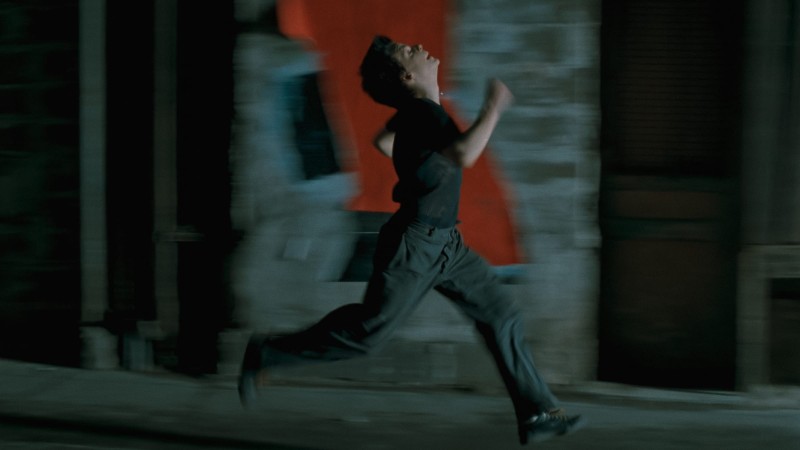
Three Films by Leos Carax: Vital Signs
With their mix of comedy, ecstasy, and aesthetic strangeness, the French auteur’s first three features grant us access to psychic states that we might not otherwise be able to enter.