Nanook of the North
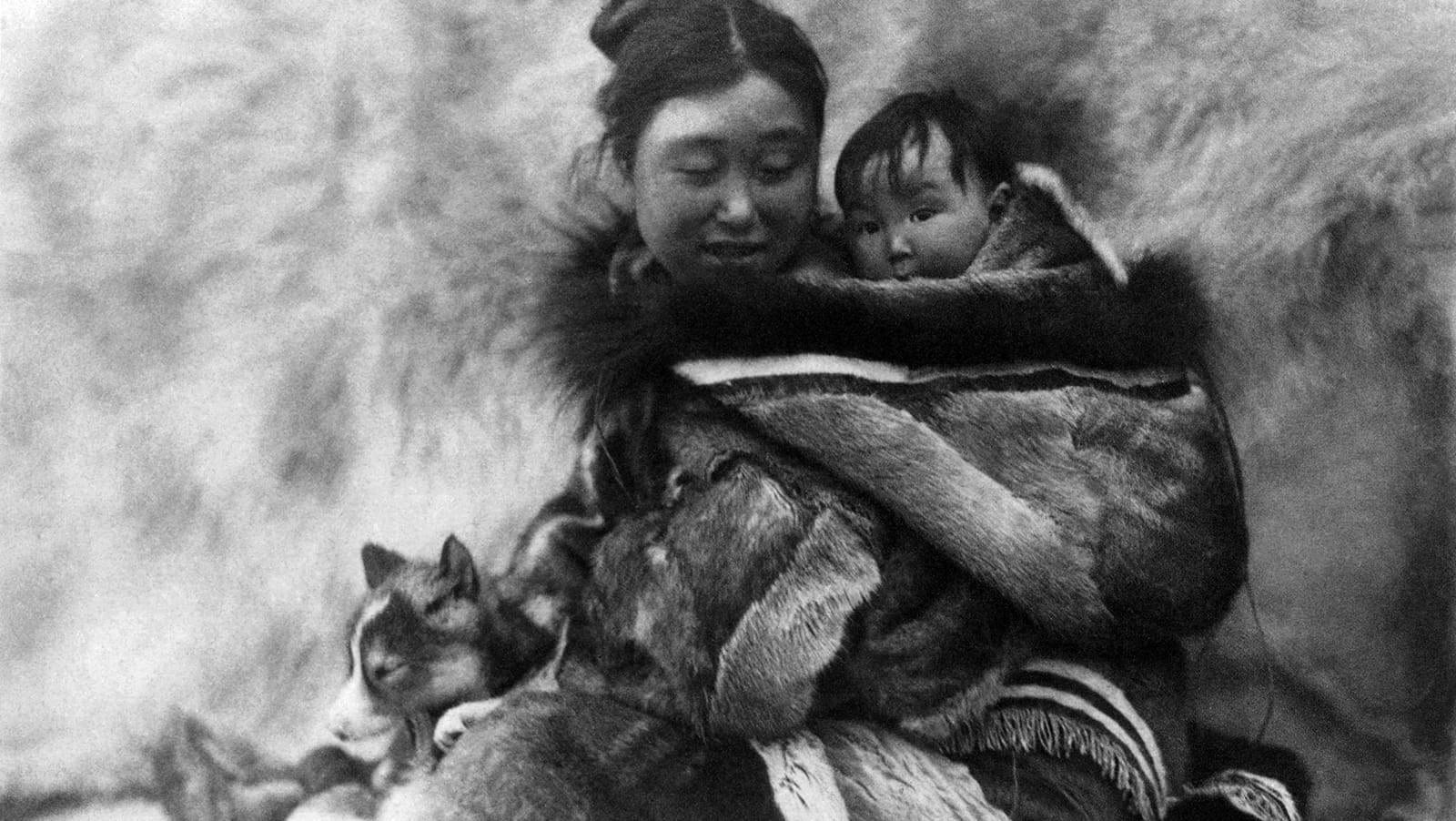
In 1910 Sir William Mackenzie hired Robert Flaherty to prospect the vast area east of the Hudson Bay for its railway and mineral potential. Over the course of several years and through four lengthy expeditions Flaherty had frequent contact with the region’s Inuit (Eskimo) people. He was taken by their traditional survival skills, and found an unexpected spirituality in this northern extreme—a profound cultural grace and dignity in a wickedly unforgiving environment. He also knew that he was witness to and a harbinger of its obliteration. What could be done? On one of his expeditions, Flaherty brought along a motion picture camera.
Nanook of the North was not initially intended as a documentary, a genre which had not even been defined at the time of the film’s production. As Flaherty’s widow Frances affirms in the interview featured on this disc, the film was made with an eye for commercial distribution and exhibition, and for audiences accustomed to narrative fiction films. Flaherty was not an ethnographer, but he was building his story out of the materials of real life. In this he was blazing cinematic trails, and even though the tenets of anthropological filmmaking were not nearly in place, it is remarkable how much he still managed to get right. Initiating a practice that would later become fundamental ethnographic etiquette, Flaherty developed each day’s footage and screened it for the participants, who were encouraged to make suggestions. Since the Inuit were the authorities on their own lives, many of these suggestions were incorporated into the film. Consistent with this substantial artistic collaboration, and contrary to a narrative and stylistic impulse that would prevail elsewhere for many more years, Flaherty does not intrude on his subject. He is not the star of his film, and though his effaced presence causes a few unsightly wrinkles (contrivances—like Nanook’s biting of the phonograph record—are presented as actual and natural), for the most part it means that the credit for the film’s feats of courage and grace goes precisely where it belongs: to the Inuit.
In its earliest years (approx. 1895–1902), film production was dominated by actualities, short pictures of real people in real places. Comprised largely of two categories—the travelogue and, more substantially, the industrial-life portrait—these films favored an unmediated view of the world over arranged spectacle. Though they gave way in popularity to the narrative fictions of Georges Méliès and Edwin Porter, they continued to be produced in great number. Robert Flaherty’s great innovation was simply to combine the two forms of actuality, infusing the exotic journey with the details of indigenous work and play and life. By so doing Flaherty transcended the travelogue, as the picturesque became a real and respectful portrait.
That portrait has two things that, even today, remain at the very core of the documentary idea. These are process and duration—the detailed representation of how everyday things are done (burning moss for fuel, covering a kayak, negotiating ice floes, hunting, and caring for children) and how long the doing takes. For instance, consider Nanook’s stunning igloo-building sequence, where labor is not only revealed in its social context, but emerges, through Nanook’s skill and Flaherty’s cinematic revelation, as an ideal of beauty and spirituality. First there is shelter, then warmth, and finally light (the window!); here and elsewhere in the film, by giving real processes a human dimension, craftsmanship and artistry become one. Nanook of the North pioneered these ideas, and it remains nearly matchless in executing them.
Nevertheless, the film is full of faking and fudging in one form or another. Observers (starting with John Grierson) would come to accuse Flaherty of ignoring reality in favor of a romance that was, for all its documentary value, irrelevant. The family at the film’s center was not at all. These were photogenic Inuit, cast and paid to play these roles. The characters’ authentic clothes were actually a nostalgic hybrid; the Inuit had started to integrate Western wear some time previously. This integration was in fact quite general: igloos were giving way to southern building materials, many harpoons had been replaced by rifles, many kayak paddles by motors. The seal that appears to be engaging Nanook in a delightful tug of war is actually dead; Nanook is in fact being pulled around by friends at the other end of the rope, standing just off camera. During the famous walrus hunt the hunters desperately asked the filmmaker to stop shooting the camera and start shooting the rifle. For his part, Flaherty pretended not to hear, and kept filming until the prey was taken in the old way. A failed bear hunt (not appearing in the film, but related in Flaherty’s northern memoir, My Eskimo Friends) left its participants, Flaherty included, stranded and nearly starving for weeks.
Flaherty’s shortcomings, as well as those of his films, are certain, and they should be acknowledged. However, it is fair to point out that, with regard to endangerments for the film’s sake, Flaherty exposes the Inuit to difficulties that are well within the realm of their traditional experience. More importantly, Nanook’s partial inaccuracies and manipulations resulted from Flaherty’s desire to preserve a sense of ancient traditions before it was too late.
When confronted with the dubious documentary status of his last film, Flaherty would emphasize its title, which was of course Louisiana Story. Likewise, an essential addition to this new version is Nanook’s original subtitle: “A story of life and love in the actual Arctic.” In making this film, Flaherty was telling a story, and from first to last he never claimed differently.