Toronto Dispatch: Clouzot Lost and Found

One enters any major film festival with hopes of discovering a budding auteur, a new voice from some previously unheard-from part of the world—a Julián Hernández or Corneliu Porumboiu or Bong Joon-ho. At this year’s Toronto International Film Festival, however, the greatest revelation for me was of an entirely different nature: an incomplete work from a well-known director dead already for thirty-two years. Henri-Georges Clouzot’s Inferno is the result of a dazzling effort by French movie historian and renowned preservationist Serge Bromberg to bring to audiences the footage from the Diabolique director’s famously unfinished 1964 film L’enfer in some semblance of narrative form. The result is a fascinating behind-the-scenes documentary and look at Clouzot’s genius (which, if you live in the New York area, you can see for yourself, at the New York Film Festival, on October 4).
According to Bromberg’s opening narration, the project was born when he found himself stuck in an elevator with Clouzot’s widow, Inès de Gonzalez, who told the famed film gleaner that she had in her possession 185 cans of original camera negative from the L’enfer shoot, never completed for various reasons, including the lead actor’s walking off the set and the director’s sudden (nonfatal) heart attack. What Bromberg discovered was truly remarkable, and incontrovertible evidence that the film might indeed have been as groundbreaking as Clouzot had always promised it would. The story of L’enfer, which came to Clouzot during a bout of insomnia, involves the paralyzing jealousy a man, Marcel (played by Serge Reggiani), feels toward his new wife, Odette (Romy Schneider), and the pathologically possessive depths to which he sinks during a summer vacation at the famed Côte d’Azur hotel la Colombe d’Or.
To reconstruct the found material into a coherent narrative, Bromberg had to fill in the blanks, which he did with some choice TV interview footage of Clouzot explaining his work, updated incidental sound synchronization, and, in one of his most surprising gambits, actors Vincent Lindon and Bérénice Bejo on a dark soundstage, reading Marcel and Odette’s dialogue from unfilmed portions of the script. Bromberg smartly and clearly structures this making-of (or, perhaps better, unmaking-of) documentary, but, of course, it’s the lost footage that has the greatest impact.
To visualize this largely internal portrait of romantic desperation, Clouzot intended to intersperse intensely colored dream sequences, X-ray-like immersions in Marcel’s twisted psyche, throughout the black-and-white narrative proper. The most astonishing footage Bromberg presents is the results of the camera and color experiments Clouzout and his various cinematographers conducted in fashioning these hallucinatory moments: eye-popping, kaleidoscopic images drenched in red, green, and blue gels; nightmarish forced perspectives; in-camera editing tricks; innovative uses of mirrors; dramatically artificial lighting. One shot, in which two actors’ faces are melded into one, anticipates Bergman’s 1966 Persona, and some of the costumes seem prescient as well—in one case, a transparent plastic coat is right out of Blade Runner. Clouzot wanted even the makeup—shimmering skin glitter, ice-blue lipstick—to evoke Marcel’s dream states.
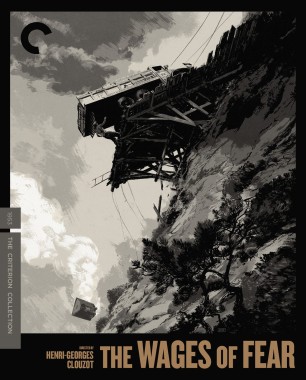
One can’t help wondering what French critics in 1964 would have thought of L’enfer had it been finished and released. As Bromberg makes clear, Clouzot was out of favor at the time, his meticulousness antithetical to the ethos of the New Wave. Yet judging by the images, L’enfer promised to be something different from his tightly wound earlier films such as The Wages of Fear and Quai des orfèvres—a bold move forward with an anything-goes attitude and a very modern, kinetic feel. This liberation could very well have doomed the project, however. Bromberg recounts how Columbia Pictures’s hands-off attitude toward the film was a mixed blessing, allowing Clouzot to lose focus and control over all the wild avenues he was exploring.
How all of this material would have coalesced we’ll never know. And this mystery is undoubtedly part of the thrill of seeing Bromberg’s film: would L’enfer have been Clouzot’s Vertigo, or just a late-career folly? This testament to Clouzot’s vision gives us enough of a glimpse to make an educated guess.