Coup de grâce
Excerpted from Hans-Bernhard Moeller and George Lellis’ Volker Schlöndorff’s Cinema: Adaptation, Politics, and the “Movie-Appropriate.
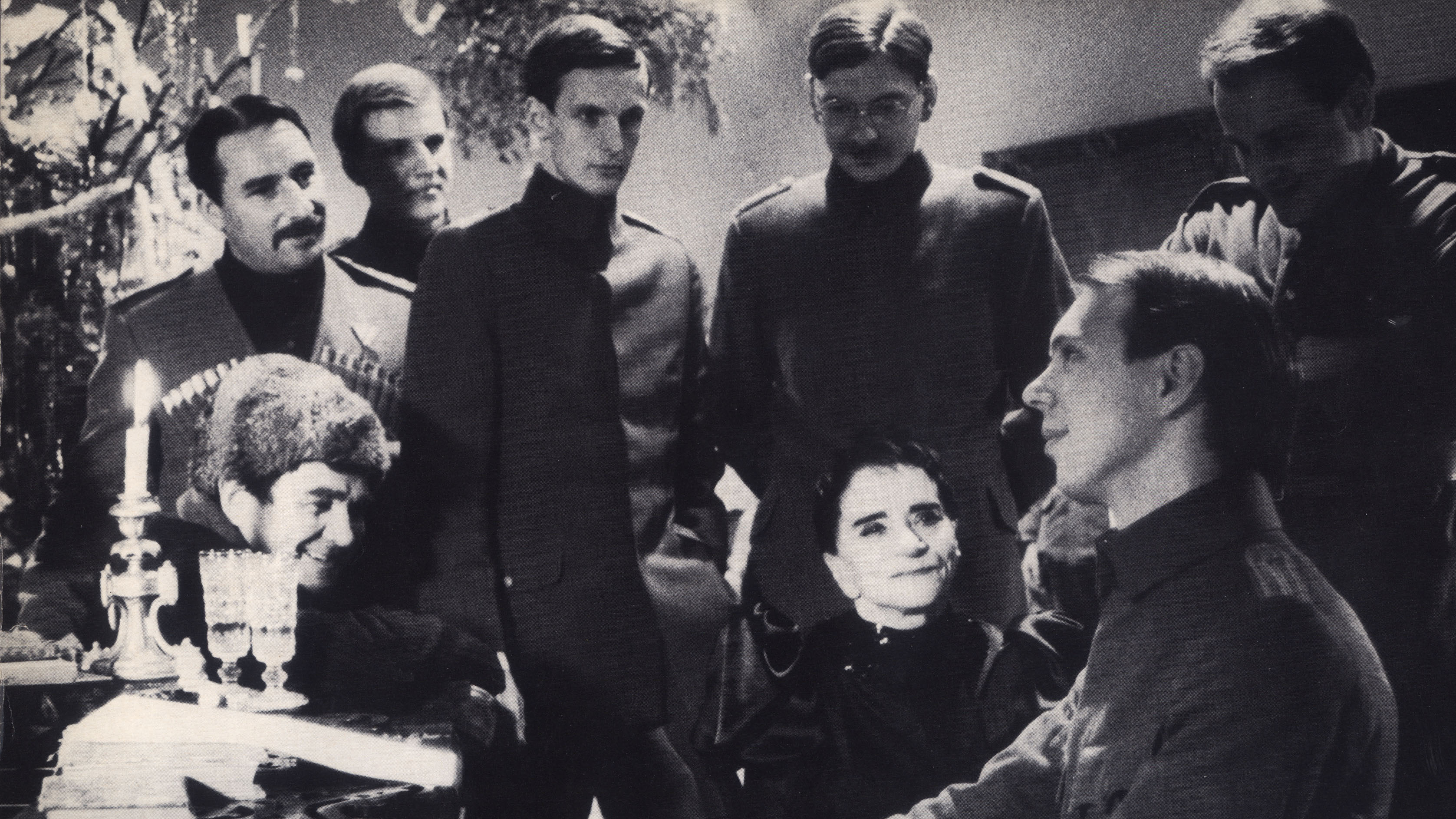
Despite its modest claims, Volker Schlöndorff’s twelfth film, Coup de Grâce (Der Fangschuss, 1976), can be considered a jewel among his creations. Adapted from Marguerite Yourcenar’s novel by the same title, this film brings the 1920s heritage to life, thanks to quilted jackets, frozen landscapes, impersonal firing squads, uniformed soldiers folk dancing at war-ravaged estates: images, sound, and texture evocative of revolutionary Russia. In addition, actress Valeska Gert, 1920s exponent of avant-garde pantomime, expressionist dance, and women’s liberation, graces the screen in one of her final performances, as Aunt Praskovia. It marks, at the same time, Schlöndorff’s return to and recapitulation of his own cinematic methods from Young Törless (1966) and The Sudden Wealth of Poor People of Kombach (1971). It presents Margarethe von Trotta, here also Schlöndorff’s screenwriter, in some of her most convincing scenes as an actress. It carries on the portrayal of rebel women in the line of A Free Woman (1972) and The Lost Honor of Katharina Blum (1975), though in more spartan visual style. In all its simplicity, this is a key work by a pivotal literary filmmaker of Young and New German cinemas.
Coup de Grâce places the reader or viewer in conditions of near-civil war that raged in the Baltic provinces near Riga in the early twenties. Radical Bolsheviks, Estonian and Latvian nationalists, German junkers, and White Russians, as well as fortune hunters and volunteer militias, attack each other. One reactionary stronghold is the castle Kratovice, ancestral home of Konrad von Reval (Rüdiger Kirschstein), who returns as an officer and finds his sister Sophie (Margarethe von Trotta). She falls in love with his comrade Erich von Lhomond (Matthias Habich), also a childhood friend, from whose masculine point of view Yourcenar’s novel is written. She politically sympathizes with village Bolsheviks, but when Erich does not return her love, she moves to the communist camp.
Schlöndorff has, in fact, reconfigured the point of view within the narrative situation: as the material changes from book form to the film medium, Sophie turns into Erich’s co-protagonist. This change proves useful to Schlöndorff’s personal set of themes, since instead of an officer and his memories, a woman moves to the forefront along with the conflicts of her emotions, her epoch, and her environment.
In the adaptation process, Schlöndorff has set up an unusual narrative structure. On one hand, he is taking a book that features a male point of view and evokes the genre of the war film––a genre usually characterized by a male point of view. On the other hand, the shift away from a first-person male narrator represents here a subverting of the war film’s usual masculine perspective.
Schlöndorff’s film develops its love-story narrative in parallel to its war-film narrative. In Coup de Grâce, Sophie’s intertwined expectations for meaningful relationships, personal happiness, and sexual fulfillment are at odds with the largely male-created universe of militarism. Schlöndorff creates a world of intimacy without sex, of sex without intimacy, and of both without happiness. In terms of film genre, the movie asks whether the traditionally configured love story can survive if the woman seeks to be the man’s equal and strives to propagate values counter to repressive masculine ones. Sophie is open, while Erich clings to orthodox formalities and appearances. She is self-disclosing, Erich evasive and even duplicitous. We are never sure whether his feelings for the contessa are sexual, fraternal, or controllingly paternalistic. This ambiguity throws audience identification onto the side of Sophie.
One particular leitmotif of the film’s indirect narrative technique draws attention to political aspects. It cinematically establishes a close link between the contessa and a captured rebel. The latter is not present in Yourcenar’s novel and thus becomes a cinema-specific addition that multiplies meanings through visual echoes and parallels. Both characters are interrogated by Erich in a way that may suggest Schlöndorff’s German point of view. Both are executed according to martial laws. Understood in a broader sense, the film actually offers two “coups de grâce.” In both cases, the business of the execution is cold and efficient; the executioners have little time. Nor does the camera allow the viewer much chance to sympathize, because both “coups de grâce” are photographed from a distance. Both times, executioners shamelessly leave corpses behind, like piles of trash.
Such touches caused a number of critics to comment on the more reserved, artistically quieter approach of Coup de Grâce. In New German Film, Timothy Corrigan positions the work as inferior to films that are more directly subversive. But Corrigan’s analysis misses many of the ways in which Schlöndorff provokes activated viewing and audience reflection. One can argue that Schlöndorff assembles an array of alienating strategies that operate subtly and scrape against the grain of a superficially realist narrative. This movie’s narrative contains many gaps and ellipses, as well as many places where, with characterizations developed only through externalized behavior, motivation is implicit or ambiguous; all of these require an alert viewer to fill in what is missing.
In her introduction to the Coup de Grâce novel, Marguerite Yourcenar insists that her intentions were not to side with any political group or party but rather to present a “study in character and emotion.” Schlöndorff achieves something different. Although it is clear that his political sympathies are not anti-Bolshevik, he never establishes whether his drama should be interpreted personally or politically and so challenges the viewer to resolve the tension between the two. It is clear that conflicts between the sexes, women’s themes, rebellion, and politics, as well as German history, offer points of contact between Schlöndorff’s film and Yourcenar’s novel. But what is most remarkable in Schlöndorff’s adaptation is the way in which, despite changes in structure and point of view, the two works remain strikingly aligned in mood, meaning, and final effect. Each shows an elegant crafting of its respective medium and a certain formal precision, and yet neither indulges in stylistic excess for its own sake. Coup de Grâce brings Schlöndorff back to the qualities that first made him successful.
Volker Schlondorff’s Cinema: Adaptation, Politics, and the “Movie-Appropriate,” by Hans-Bernhard Moeller and George Lellis. ©2002 by the Board of Trustees, Southern Illinois University, reprinted by permission of the publisher.

More: Essays
West Indies: The Fugitive Slaves of Liberty: Torrents of Fire, Torrents of Blood
Unfolding in a blaze of vivacious color, Med Hondo’s musical masterpiece is a wildly ambitious exploration of the history of French colonial aggression, the enslavement of African peoples, and their subsequent liberation struggles.

Sentimental Value: Between Trauma and the Sublime
In this powerful drama about family and memory, Joachim Trier explores how the past lives on in us, shapes us, and partly determines who we are and how we feel.
Lenny: High-Wire Act
Featuring a quasi-documentary format that was innovative for its time, Bob Fosse’s complex portrait of stand-up comedian Lenny Bruce is a gesture of postmortem outreach from one prickly, jagged-edged artist to another.

Fresh Kill: Fluid Transmission
New-media pioneer Shu Lea Cheang’s astonishingly prescient dystopian vision takes place in a world where technology feels sticky and bodily, and where networks seep into food, water, and flesh.