On Jules and Jim

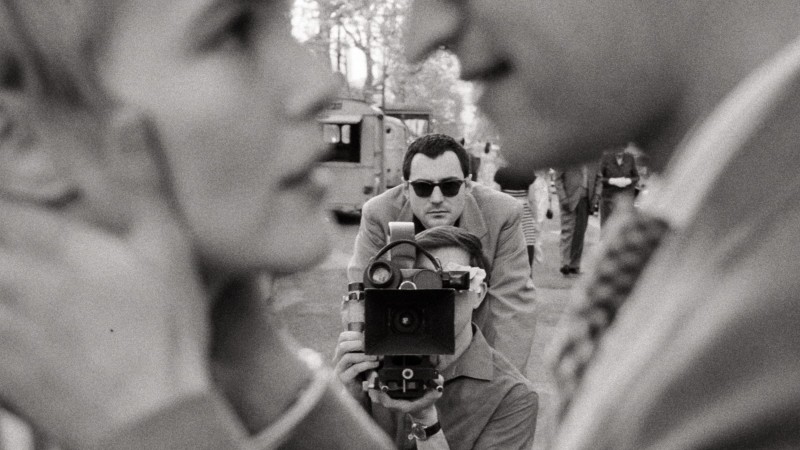
When François Truffaut was a twenty-three-year-old film critic, in 1955, he read an autobiographical first novel by a seventy-four-year-old writer, Henri-Pierre Roché. “The book overwhelmed me,” he later recalled, “and I wrote: If I ever succeed in making films, I will make Jules and Jim.” Six years later—after constantly rereading and even partly memorizing Roché’s novel—he more than redeemed that promise. Sixties audiences didn’t merely see his movie. They wanted to live it.
Jules and Jim begins in Paris before World War I and introduces us to two aspiring writers. Jules is a shy, diminutive Austrian (Oskar Werner is all pained charm), a born onlooker who masks his aggressiveness as passivity. He can’t get the girls, but his friend Jim can. A lanky, not-quite-dashing Frenchman (played with melting standoffishness by Henri Serre), Jim is a Left Bank Don Quixote to Jules’s Sancho Panza. When we first meet them, they are living out a genial but somewhat lackluster bohemianism, brimming with talk about writing and women. But for all their love of books, these pals come alive only when they meet the magnificently desirable and dangerous Catherine (Jeanne Moreau). She marries the stolid Jules, who’s too low-key and dull to keep her, and becomes the lover of Jim, who refuses to subject himself to her will.
Although the film is named for the men, its animating force is Catherine, a creature both utterly timeless (Jules and Jim first see her visage in a photo of a Greek statue) and forever changing: at different points, she plays the roles of Charlie Chaplin and street tough, vamp and doting mother. Passionate and iconoclastic, she is, in fact, the only true free spirit among them. Just as the men put their talent into their art, so she puts her genius into living—or perhaps into claiming for herself the reckless male freedoms that women have been traditionally denied. Time and again, she literally dresses herself in the garb of masculinity.
On paper, the mercurial Catherine seems an implausibly grandiose conception, a woman both giddy and tragic, protofeminist and male-dominated, driven by Eros and Thanatos. But as played by Moreau, a pop-eyed siren with the ferocity of Bette Davis and the kitty-cat wiles of Tuesday Weld, Catherine becomes one of the modern movies’ triumphant characterizations—the anima as autocrat. Whether playing with vitriol or jumping into the Seine, she elevates capriciousness to an existential principle. When Jim says he understands her, she replies, “I don’t want to be understood.” And this is absolutely true. The movie lives in the shuddering distance between Catherine’s imperious, doomed physicality and the two men’s shifting perceptions of her, perceptions that rearrange but never destroy their glowing friendship.
Jean-Paul Sartre once wrote that the greatest art is about the passing of time. Jules and Jim flies by like a dream, suffused with a sense of life’s evanescence. As the characters grow older, and perhaps wiser, we become aware of how much has been lost—loss of love, loss of innocence, loss of the marvelously lamplit bohemian past to the searchlight horror of Nazism. An intimate melancholy pervades the movie’s voice-over narration, which adores the characters’ brave inquiry into love’s possibilities but is also wryly aware of the relief that accompanies the end of such inquiries. As critic Andrew Sarris once wrote, Jules and Jim celebrates “the sweet pain of the impossible and the magnificent failure of an ideal.”
From the beginning, the film itself was treated as a magnificent success, with Truffaut winning praise from such personal heroes as Jean Cocteau and Jean Renoir; he even received a gushing letter from the seventy-five-year-old Helen Hessel, the real-life, Seine-jumping model for Catherine, who told him he’d captured “the essence of our intimate emotions.” Such accolades, however, didn’t keep France’s Commission de contrôle des films from forbidding viewers under the age of eighteen from seeing Jules and Jim because of its “immoral character”—a decision that would be replicated in many other countries. From our present-day vantage point, when nudie sex scenes are de rigueur on cable TV, such a decision may seem incredible. But this was 1962, and while the New Wave may have been reinventing cinema, French censors weren’t ready to reinvent bourgeois morality.
Perhaps a bit naively for a Young Turk, Truffaut was shocked by the ban, but he clutched at the nearest straw. The president of the commission, Henry de Ségogne, told him that the board might reconsider if he could gather a series of laudatory statements from luminaries. Truffaut set about doing just that, writing to Cocteau, Renoir, and Alain Resnais requesting their support. Still, despite this illustrious backing, the commission refused to reverse its original decision, condemning itself to a tiny corner in the Pantheon of the Square, while this supposedly immoral movie would one day be shown in high school classes.
Truffaut was not yet thirty when he made this tale of triangular desire, and decades later it’s still astonishing that one so youthful could be so openhearted, so willing to give everyone’s motives and passions their due. But if Jules and Jim casts a mature eye on the limits of freedom (by the end, everything seems uncannily, but satisfyingly, preordained), it remains indelibly a young man’s movie. It’s a lyrical joyride propelled by leaping, elliptical edits, Georges Delerue’s sublimely evocative score (one of the most memorable in film history), and Raoul Coutard’s ecstatic photography, which helps underscore Truffaut’s visual ideas about the great circle of life. At one point, Coutard’s camera follows a young woman in a bar, does a 360 degree pan, and winds up watching Jules draw another girl’s face on the surface of a round table.
Almost every scene is shot through with such casual stylistic brilliance. Yet what audiences have always loved about this movie isn’t simply its technical brio but its emotional warmth, its embrace of a world in which tragedy is forever playing hopscotch with farce. Jules and Jim is a movie that enters viewers’ lives like a lover—a masterpiece you can really get a crush on.
This essay is a revised version of one that originally appeared in the Criterion Collection’s 2005 DVD release of Jules and Jim.