The Fallen Idol
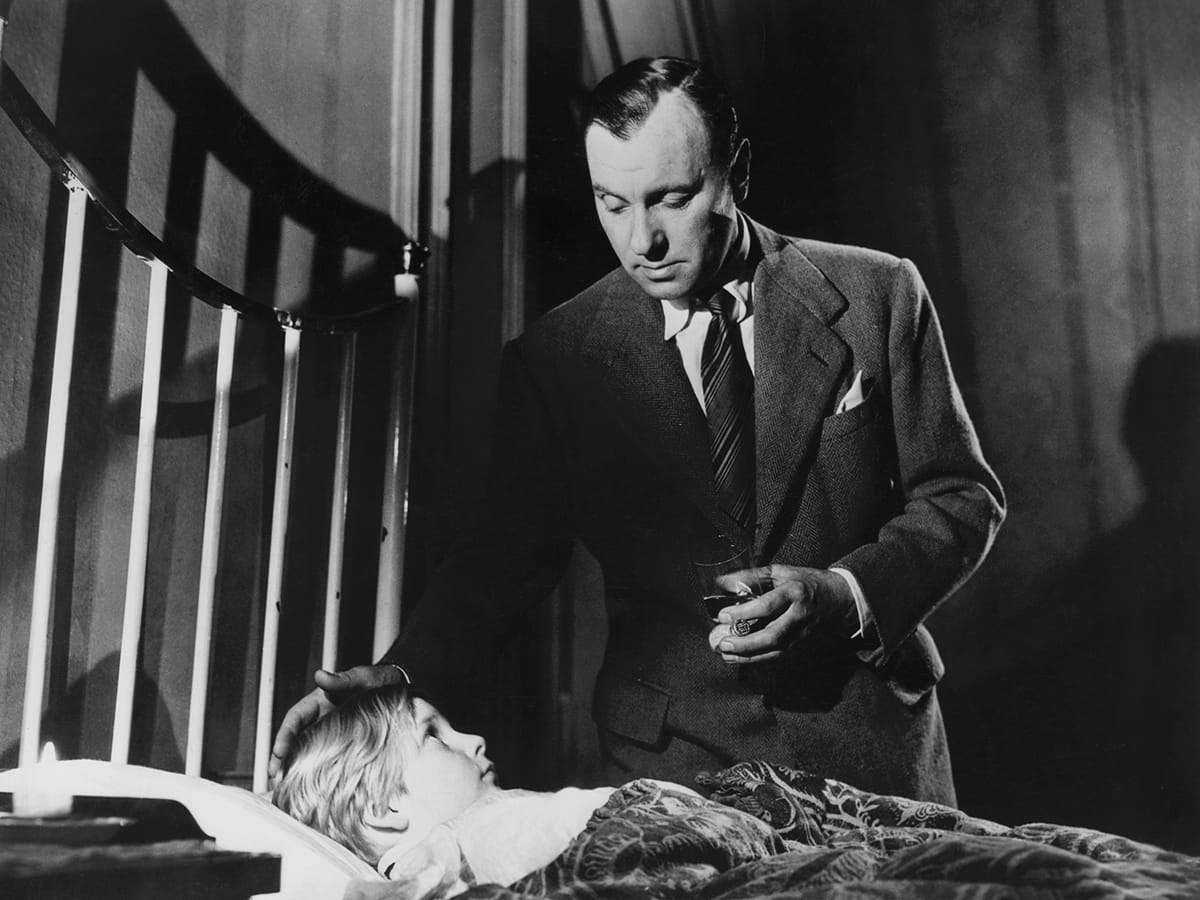
At first blush, The Fallen Idol might seem to be an ambered treasure, duly noted in the guidebooks as “worth a special visit.” It has, after all, a script by noted littérateur Graham Greene; it plays upon the classic themes of trust, innocence, betrayal, truth; its story is one of passion among the servant classes, as perceived (and misperceived) by Master Phillippe, the obligatorily precocious eight-year-old. In short, you might be tempted to see The Fallen Idol as ur-Masterpiece Theatre—the kind of ostentatiously understated thing the British do so terribly well, as what’s been referred to as “the Laura Ashley school of filmmaking.”
And you’d be dead wrong.
Because what all this honeyed veneration fails to describe is just how damn much fun the The Fallen Idol is. And, for all its quality and craft, how little it has lost its power to disturb—and to haunt.
Chalk some of this up to Mr. Greene, who, when slumming from his official masterpieces and meditations on lapsed faith, churned out a string of what he termed “entertainments”—including The Third Man, Ashenden, and the short story The Basement Room, which he here (with “additional dialogue” by Lesley Storm and William Templeton) adapted for the screen.
And, without doubt, chalk some of this up to Carol Reed, perhaps best known for The Third Man, which he filmed later the same year. Here Reed takes what will become a trademark visual style—Dutch tilts, chiaroscuro lighting, deep-focus tableaux—and deploys it in service of a script set largely within the interior of one house. As we watch, that house becomes a city, and the entry hall, with its wrought-iron-and-marble central staircase, every bit as evocative as the gleaming cobblestones of Harry Lime’s Vienna.
The plot of The Fallen Idol is simple. Young, innocent, towheaded Phillippe (Bobby Henrey), son of the French ambassador, finds in his butler Baines (Ralph Richardson) the attention and warmth that his somewhat distant father has failed to supply. Baines tells him stories, takes him for walks, and helps him circumvent the Draconian household order imposed by Mrs. Baines (Sonia Dresdel).
The ambassador departs, to retrieve his long-hospitalized wife, and Phillippe is left to the charge of his servants. Confined to his room by Mrs. Baines, the boy of course escapes and, spotting Baines, follows him to a teashop—where Baines is in the middle of a difficult, tearful conversation with the attractive Julie (Michele Morgan), whom Baines stammeringly introduces as his niece. Phillippe accompanies the lovers on a walk through town, a trip to the zoo— a romantic crisis for the adults, a family romance for the child. He is told by Baines to keep the events of the day a deep, deep secret.
But the normally tyrannical Mrs. Baines, in a spasm of tenderness, draws the story out of him. She spies on her husband, catching him in flagrante . . . And moments later, with a thump and a scream, there’s a body, arms and legs splayed at impossible angles, at the foot of the ornate marble stairs, and a boy who thinks he’s witnessed a murder committed by the only person in the world he really loves.
Following his 1946 classic Odd Man Out, which proved to be both a succés d’estime and a box-office hit, Sir Carol Reed found himself wooed by mogul Alexander Korda, who wanted Reed to work under Korda’s London Films banner. To this end, Korda introduced Reed to Graham Greene. The introduction proved to be more congenial than perhaps even Korda had imagined, and the subsequent collaboration resulted in both The Fallen Idol and The Third Man. Greene later described Reed as “the only director I know with that particular warmth of human sympathy, the extraordinary feeling of the right face for the right part, the exactitude of cutting and not least important the power of sympathizing with an author’s worries...”
The faces here are, without doubt, the right ones. As Baines—at once the clumsy, frightened adulterer and the intrepid surrogate father—Ralph Richardson rules. His deep, insinuating voice never seems more certain than when he’s telling a lie—or more tentative than when speaking, finally, the truth. Sonia Dresdel attacks her role fearlessly, certainly not a sympathetic figure, but never merely a harridan. Michele Morgan is lucid as Julie; and the supporting cast includes the great Jack Hawkins as well as Bernard Lee, perhaps better known as “M”—James Bond’s crusty boss. But it is the remarkably unmannered Bobby Henrey who occupies the center of this narrative. It’s through his eyes that the action is observed, and through his actions that the drama, within and without, relentlessly unfolds.
But it detracts neither from the performances nor from Greene’s crafty, allusive script—Pinter avant le lettre—to say that the real star of The Fallen Idol is the embassy itself: its marble checkerboard receiving parlor, its outsized catenary staircase. From the film’s opening, when Henrey stares poignantly through the newel posts at his father’s departing entourage, to the final bit of detective work at the end, it is the physical space of the film that ultimately remains. For all its other virtues, The Fallen Idol leaves us with a dark, splendid moral ambiguity—and with that set of stairs, massive, curvilinear, indelible. It is a staircase as poignant as the one in Letter from an Unknown Woman, as full of drama as the one in The Magnificent Ambersons, as riveting as the one in Suspicion.
And, perhaps, as deadly as the one in Psycho.
Or perhaps not.

More: Essays

Sentimental Value: Between Trauma and the Sublime
In this powerful drama about family and memory, Joachim Trier explores how the past lives on in us, shapes us, and partly determines who we are and how we feel.
Lenny: High-Wire Act
Featuring a quasi-documentary format that was innovative for its time, Bob Fosse’s complex portrait of stand-up comedian Lenny Bruce is a gesture of postmortem outreach from one prickly, jagged-edged artist to another.
Fresh Kill: Fluid Transmission
New-media pioneer Shu Lea Cheang’s astonishingly prescient dystopian vision takes place in a world where technology feels sticky and bodily, and where networks seep into food, water, and flesh.
Body Heat: The Trap You Set for Yourself
In his stylish and provocative directorial debut, Lawrence Kasdan uses the vehicle of a sex-and-murder plot to explore the film’s historical moment, which gave rise to the greed and amorality of the Reagan era.