Fiend Without a Face
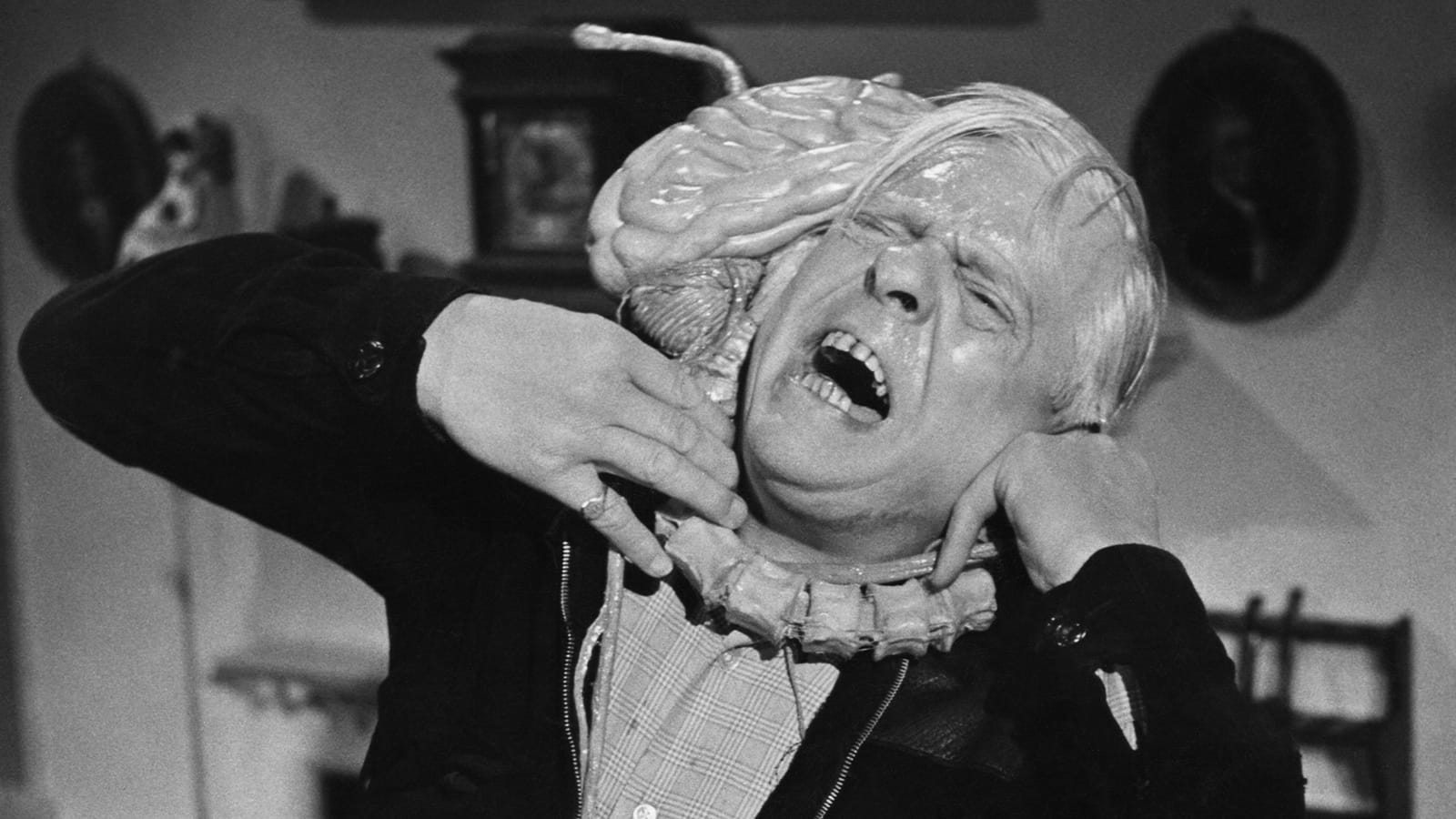
Invisible monsters suck out your brains!
And that’s just for starters. They suck out your spinal cord too. They make crunchy, slurpy, thumping sounds when they crawl. They strangle you with something when they leap on you and bite through the back of your head. You die with a look of insane horror on your face, the final realization as you feel yourself vacuumed into oblivion. Mental vampires, they began as thoughts that have been materialized and freed. With enough atomic energy, they become visible: brains whose tails of spinal bones have wrapped around each victim’s neck—tails they can use to inchworm along or to leap; brains with antennae and some kind of armor that makes them tough instead of squishy. They are terrifying when we cannot see them, horrifying when we can.
By the time the monsters have been shown and explained, Fiend Without a Face has not exhausted its material but instead gotten its second wind. With its effective camerawork and revolting sound effects, it has merely set the stage for the goriest, grossest climax of the fifties, an outrageous gun battle against flying, splattering brains. When they’re shot, they make a puttering, plopping sound as they bleed and collapse. When the reactor control room is blown up (sure) and the power is cut off, they fizz and hiss as they putrefy and melt. If the “mental vampire” has a symbolic edge, it’s the evil potential of atomic power.
But the problem isn’t atomic power or the Bomb; this isn’t a movie like Them! Or The Day the Earth Stood Still. The problem is nuclear energy in the wrong hands: the old loner scientist who diverts the power for his own uses and creates monsters he can’t control. Like Dr. Jekyll and Dr. Frankenstein, he goes too far, and he suffers for it. But if everyone cooperates, we can live safely around nuclear power, much as the cows are said to have gotten used to the jets that roar over the farm. As the jets freaked them out and temporarily interfered with their milk production, the human characters confront a gigantic disruption in their lives, kill the monsters, and go on in a restored, quieter world. In love.
The script, by Herb J. Leder, was based on Amelia Reynolds Long’s story “The Thought Monster,” published in 1930 in the greatest of the pulp horror magazines, Weird Tales. The director, Arthur Crabtree, a former cinematographer, had a gift for generating suspense in tight spaces on a low budget; his films include Madonna of the Seven Moons (1944) and Horrors of the Black Museum (1959). The sharp, evocative cinematography was by Lionel Banes; and the stars were Marshall Thompson (Major Jeff Cummings), Kim Parker (Barbara Griselle), and veteran character actor Kynaston Reeves (Professor R. E. Walgate), who appeared in films as diverse as The Lodger (1932) and School for Scoundrels (1960). Except for some second-unit work in Canada, Fiend was shot in England, where the special effects were directed by Peter Neilson. The stop-motion animation, however, was directed by Baron Von Nordhoff and carried out by K.L. Ruppel; they did all their work n Munich. Such internationalism is appropriate for a British picture set in Canada, released by MGM, and based on a story that appeared in an American pulp. Even if some of the dialogue is corny and the characters are formulaic (one available man, one available woman, one driven scientist…), the script as a whole is functional and tight; perhaps its best ironic flourish is the jet that disturbed his cows. Under Crabtree’s fine direction, the actors make us care about the formulaic characters; they become interesting, even compelling. The special effects—both the sound effects and the stop-motion animation—rank with the best of the period. The blend of horror and science fiction is seamless.
If this movie is formulaic, it also goes beyond formula to a gravely determined and inventive stance of its own. It has the courage of its monster, a monster it knows is worth putting at the center of a horror film, and it has the courage of its ideas and elaborated premises, which are logical enough to keep its science fiction from ranging into the preposterous. The film intrigues and frightens because it has an urgent tone and a methodical escalation that are so firmly grounded in this dangerous, twisted world that they refuse to become dated.
In the United States, a slightly censored version of Fiend Without a Face opened in June 1958 on a double bill with The Haunted Strangler. (Criterion’s edition is, of course, complete.) Teens were thrilled, critics were repulsed, and after a short run it closed. As if carrying out in reverse the life cycle of its monster, the movie vanished and then became only a memory in the mind of its fans: a thought.

More: Essays

West Indies: The Fugitive Slaves of Liberty: Torrents of Fire, Torrents of Blood
Unfolding in a blaze of vivacious color, Med Hondo’s musical masterpiece is a wildly ambitious exploration of the history of French colonial aggression, the enslavement of African peoples, and their subsequent liberation struggles.

Sentimental Value: Between Trauma and the Sublime
In this powerful drama about family and memory, Joachim Trier explores how the past lives on in us, shapes us, and partly determines who we are and how we feel.

Lenny: High-Wire Act
Featuring a quasi-documentary format that was innovative for its time, Bob Fosse’s complex portrait of stand-up comedian Lenny Bruce is a gesture of postmortem outreach from one prickly, jagged-edged artist to another.
Fresh Kill: Fluid Transmission
New-media pioneer Shu Lea Cheang’s astonishingly prescient dystopian vision takes place in a world where technology feels sticky and bodily, and where networks seep into food, water, and flesh.