The Man Who Fell to Earth
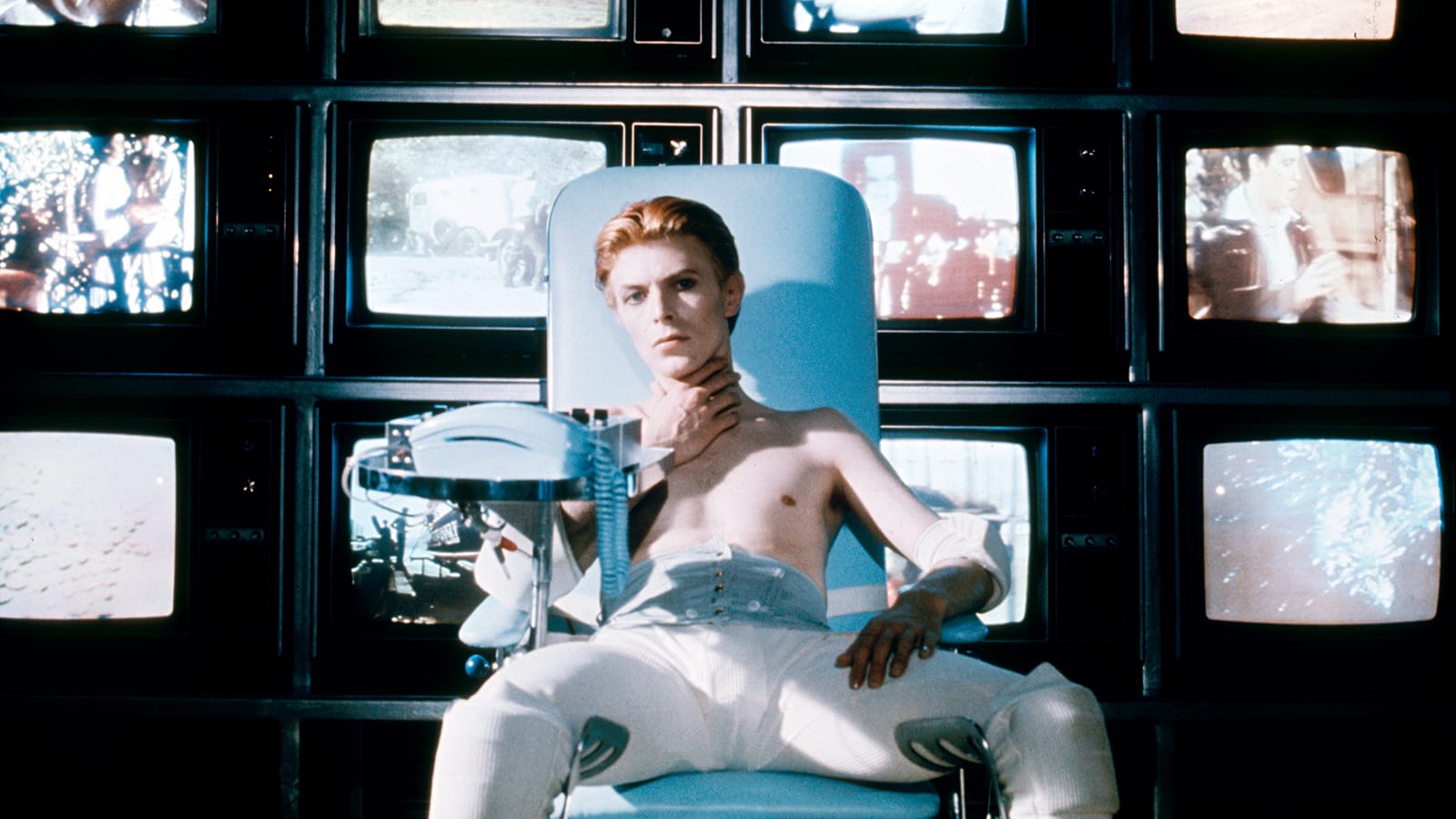
Released the year before Close Encounters of the Third Kind and Star Wars, Nicolas Roeg’s The Man Who Fell to Earth is a science-fiction film without science, a terrestrial space opera minus matte shots, models, or pyrotechnics that leaves us not wondering at the stars but grieving for ourselves. Maddeningly structured, defiantly ambiguous (some say incoherent), yet powerfully moving, it was described by its director at the time of its release simply as “a mysterious American love story.”
The Man Who Fell to Earth is a serious film that runs to garishness, a cerebral film flooded with emotion, in which plot counts less than picture and event less than essence, silence carries as much weight as speech, and much remains intentionally unexplained. “If questions are answered patly,” Roeg has said, “the audience is distanced.” That attitude has created a career’s worth of troublesome, even anti-logical movies—from Performance, Walkabout, and Don’t Look Now in the 1970s to Insignificance and Track 29 in the 1980s—that trust the viewer to gather, sort, and tie together (or not) the loose ends. Although unsympathetic critics deem it a failing, it’s the very quality that makes Roeg a revival house perennial.
In The Man Who Fell to Earth, adapted from a 1963 novel by Walter Tevis (who also wrote The Hustler), the director is at his most flamboyantly fractured. Screenwriter Paul Mayersberg has described its parade of scenes as “circus acts following one another—the funny, the violent, the frightening, the sad, the horrific, the spectacular. “ Roeg delights here in “taking away the crutch of time” (“It has puzzled people whehter 25 minutes or 25 years have passed in the film”), eliminating transitions, cross-cutting, flashing forward and back, piling dissolve upon dissolve, letting the camera jerk and twirl and zoo—finding new ways to see familiar things, while speculating on what the world might look like to someone from Out There. Pauline Kael called Roeg “perhaps the most visually seductive of directors, and this is a film of symbols and visions: a white horse running in twilight, a sequence of stars turning to fireworks turning to city lights, water exploding backwards into a lake.
From this hallucinatory mix can be distilled the tale of a space traveler who comes to Earth seeking relief for his drought-stricken planet. Images of water, from cloud to ice cube, play against those of burning sun and sand; cool hues war with warm Earthly diversions distract him from his mission, earthly agents imprison and discard him. Fatally innocent, he ends drunk and lonely, lost among humans and trapped in human skin. There are scattered echoes of the mythic (Icarus the fallen, Christ the descended and martyred), along with indictments of contemporary wastelands: government, academia, television (used here as a kind of Greek chorus). In fact, The Man Who Fell To Earth is fundamentally about wastelands—ecological, cultural, and most of all, personal.
As the alien, sporting a British passport and the fitting name of Newton (Sir Isaac’s second law—the one about entropy—suggests a key theme), Roeg cast David Bowie. As Roeg’s second rock-star lead—Mick Jagger first turned actor in Performance—Bowie is remarkably effective and unaffected. In a way, Bowie had already cast himself in the role, having made his mark in the guise of Ziggy Stardust, an androgynous, eyebrow-less pop star from space, clad in Flash Gordon garb that spawned glitter-rock. Like Newton, he was a man in a mask and, at the time, in a compatible state of real-life nervous exhaustion. Antiheroic to a fault in the mid-1970s mode, he fit uncannily Tevis’ original description of Newton, with his “almost transparent skin . . . graceful woman’s hand . . . strong, unmanlike, unsexual, natural.”
Other casting choices were just as inspired: screenwriter/actor Buck Henry (The Graduate) underplays Bowie’s corporate right hand; cult leading man Rip Torn (Payday) is a “disillusioned scientist” who befriends and betrays the alien; and football star Bernie Casey incarnates the amoral moralism of a government intelligence don Best of all is the remarkable Candy Clark—fresh fron an Oscar nomination for American Graffiti—as Mary-Lou the hotel clerk who becomes Newton’s consort. She finds courage and anguish in a character a lesser actress might have played as dumb and selfish. Her scenes with Bowie, including some highly charged, absolutely natural sex scenes (a Roeg trademark) are the film’s emotional spine.
This is, after all, “a love story.” But it’s Roeg’s constant theme that love has its limits. “We can’t explain much to each other,” he has said “The eternal lover’s question is ‘What are you thinking about?’ “His film are full of characters who, like Newton and Mary Lou, connect only fitfuly and never quite understand one another, yet are required by the fate that binds them, to try The question of stalled intimacy, of short-circuitred communication, is closest to Roeg’s heart. Commenting on a later film, Bad Timing: A Sensual Obsession, Roeg observed “We’re trapped in our shells. Skin can be beautiful one moment and frightening the next.” The Man Who Fell to Earth is a precise, even literal, expression of that idea.

More: Features

Small Town, Big Money: Capitalism Runs Amok in Turumba
In Kidlat Tahimik’s playful and unpredictable film, a Philippine village is tasked with manufacturing thousands of figurines for the Olympic Games, upending the lives and customs of the local population.

The Sudanese Film Group’s Legacy of Political Resistance and Creative Liberation
The members of this influential leftist collective created a formally adventurous body of work that examined the nation’s tumultuous history through a postcolonial lens.
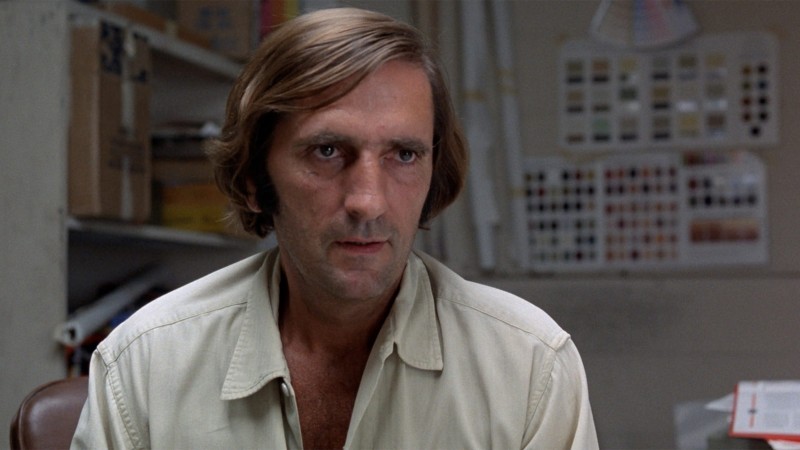
Get Me Out of Here: Harry Dean Stanton in Straight Time
In one of his greatest performances, the celebrated actor shows off his range by fusing the two modes that defined his career: the misanthropic provocateur and the soulful survivor-witness.
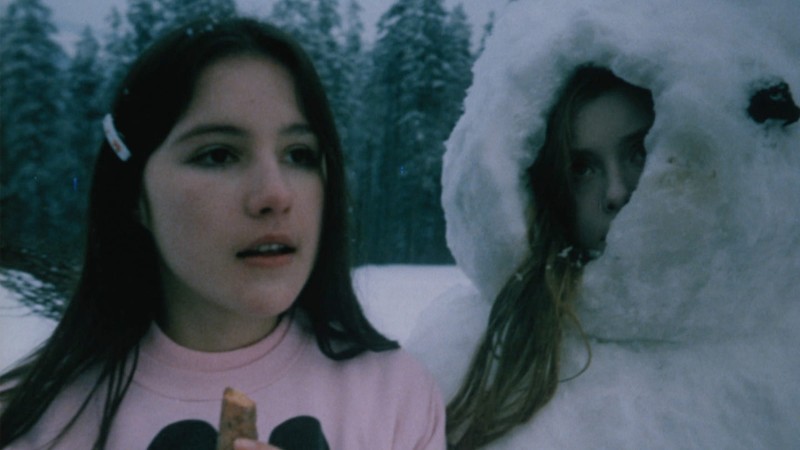
Věra Chytilová’s Boldly Antiauthoritarian Take on Teen Horror
A characteristically rebellious work from the Czechoslovak New Wave pioneer, Wolf’s Hole explores the perilous absurdities of groupthink through the story of eleven youths held captive at a skiing retreat.