Wild Strawberries
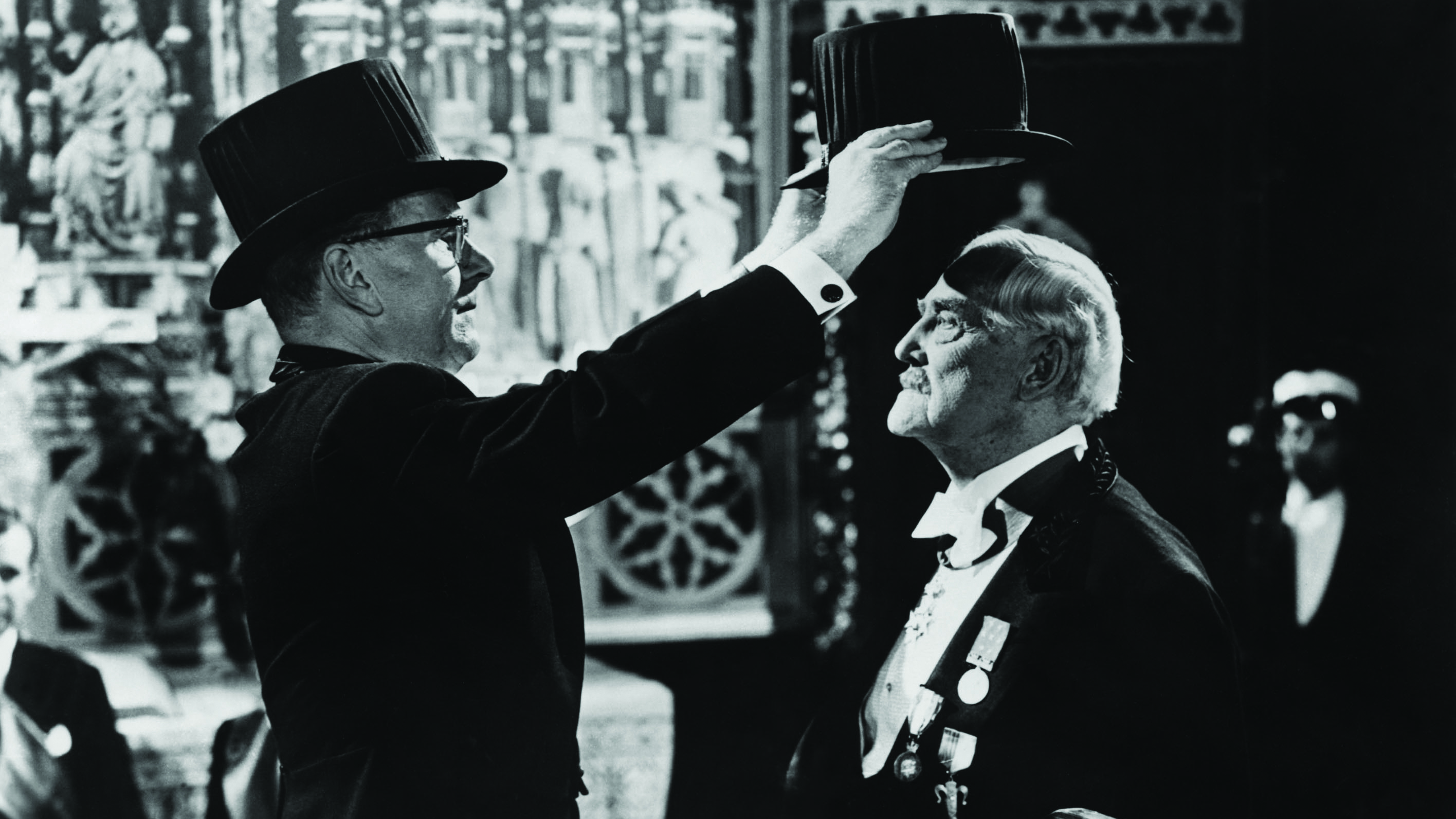
The opening nightmare in Wild Strawberries comes as a shocking reminder of death to Isak, the film’s central character. He finds himself in the Old Town of Stockholm, assaulted by a burning sun. He plunges hastily into the few patches of shadow that the street affords. Gateways loom, great areas of black, used by director Ingmar Bergman to suggest a hostile nothingness. Isak is alone, faced by successive portraits of disaster: a watch without hands, a human figure that crumbles on the sidewalk, a coffin that contains his own body.
Ingmar Bergman is still startled by the speed at which the years pass. He remembers the smallest things—toys, noises, smells, light. “When I look at my brother,” he told Liv Ullmann “it seems it was only yesterday we were running barefoot in the garden, and I feel a fear inside me.”
In the spring of 1957, immediately after directing a television version of Hjalmar Bergman’s Mr. Sleeman is Coming (his first contact with the new medium), Ingmar Bergman settled down to write the screenplay for Wild Strawberries—a film dealing with that “fear.”
There was no difficulty in setting up the project. The success of The Seventh Seal and the foreign sales of Bergman’s movies had convinced Svensk Filmindustri that they had an asset on their hands. That organization’s Carl Anders Dymling, in fact, persuaded the aged and ailing director Victor Sjöström (The Wind, He Who Gets Slapped) to take the part of Isak Borg. Sjöström was seventy-eight years old and sometimes querulous. He was a lonely man whose wife was dead. His health was poor, and during the filming he often forgot his lines, a failing that would only aggravate him the more. Cinematographer Gunnar Fischer says that several scenes had to be shot indoors for Sjöström’s sake. “We had to make some very bad back-projection in the car because we never knew if Victor would come back alive the next day.” Nevertheless, as long as Victor was home by 5:15 P.M. each day, “and had his whiskey punctually, all went well.”
The phenomenon of old age wherein childhood memories return with ever-increasing clarity while great stretches of the prime of life vanish into obscurity is the nub of Wild Strawberries.
Isak Borg, the distinguished professor emeritus who lives alone with his housekeeper, can only come to terms with his egocentricity by traveling back in time to his earliest youth, finding there the seeds of his failure as husband, lover, and father.
The opening nightmare sequence seems a tribute to Sjöström’s own great silent film, The Phantom Carriage. Sound effects, as in the opening flashback of The Naked Night, leave a deep impression. The silence at one point is so profound that Isak becomes aware of his own massive heartbeat. When the carriage crashes into a lamppost and disgorges its casket, the axle squeals insistently, like a newborn baby, suggesting the proximity of birth and death. Bergman has always been aware of the importance of the soundtrack, seeking a little extra sound that will give a scene an added dimension.
The set for this sequence was built on the lot at Råsunda, but the shot of the carriage rounding the street corner was taken by Gunnar Fischer in a deserted Old Town at almost 2 A.M. one summer morning. A couple emerging from a restaurant was startled by the spectacle of a coach without a driver hurtling down the narrow, cobbled lane. The dummy that Borg mistakes for a pedestrian was constructed from a balloon and a silk stocking. All the walls had to be painted pure white to achieve the glare that Bergman wanted.
Wild Strawberries won the Golden Bear at the Berlin Film Festival in 1958 and was acknowledged around the world as the seal on Bergman’s career. Gunnar Fischer’s cinematography and the haunting regretful music of Erik Nordgren are beyond reproach. The warmth and gentility of Victor Sjöström’s performance render Isak Borg a character so sympathetic that the audience sides with him, however damning the accusations.
Some months after the opening of the film, Bergman met a childhood friend, who told him that while he was watching Wild Strawberries he “began to think of Aunt Berta, who was sitting all alone in Borlänge. I couldn’t get her out of my thoughts, and when my wife and I came home, I said let’s invite Aunt Berta over at Easter.”
That, says Bergman, is the best review he has ever had.

More: Essays
Sentimental Value: Between Trauma and the Sublime
In this powerful drama about family and memory, Joachim Trier explores how the past lives on in us, shapes us, and partly determines who we are and how we feel.
Lenny: High-Wire Act
Featuring a quasi-documentary format that was innovative for its time, Bob Fosse’s complex portrait of stand-up comedian Lenny Bruce is a gesture of postmortem outreach from one prickly, jagged-edged artist to another.

Fresh Kill: Fluid Transmission
New-media pioneer Shu Lea Cheang’s astonishingly prescient dystopian vision takes place in a world where technology feels sticky and bodily, and where networks seep into food, water, and flesh.
Body Heat: The Trap You Set for Yourself
In his stylish and provocative directorial debut, Lawrence Kasdan uses the vehicle of a sex-and-murder plot to explore the film’s historical moment, which gave rise to the greed and amorality of the Reagan era.