Notorious
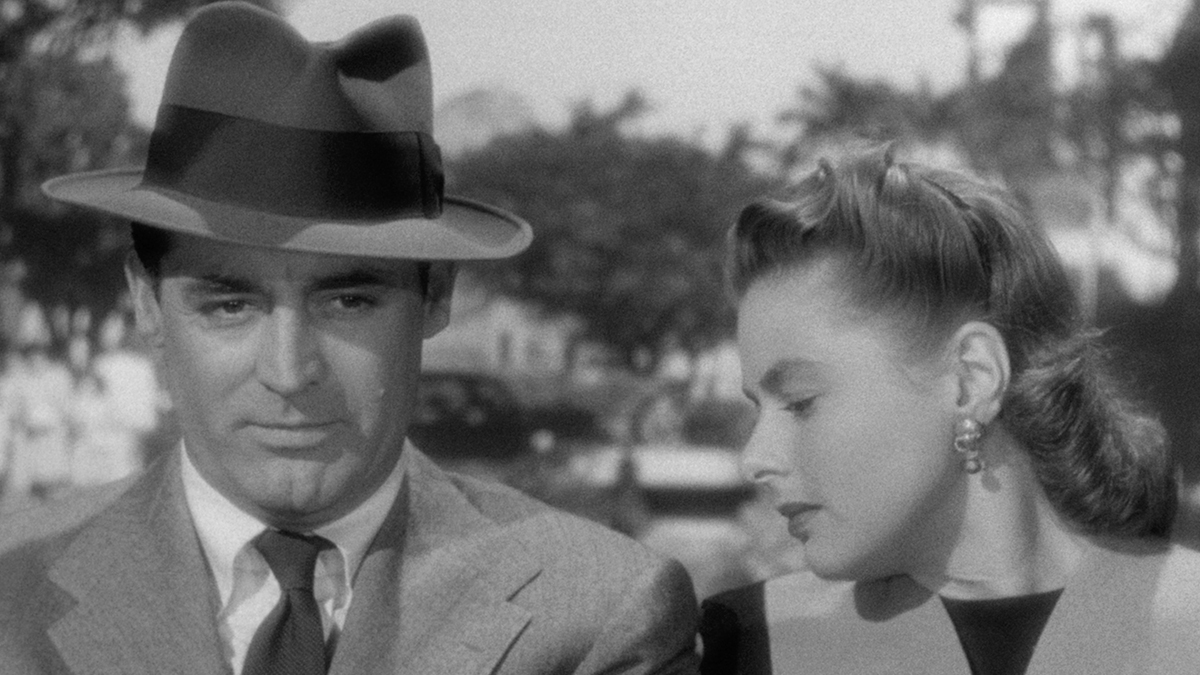
Notorious is, along with Shadow of a Doubt, the greatest of the films Hitchcock made in his first decade in America. Indeed, I have no inclination to disagree with François Truffaut when he cites Notorious as the single work that provides the fullest representation of Hitchcock’s art. Unlike Foreign Correspondent and Saboteur, which seem like over-the-top remakes of British thrillers like The Lady Vanishes, Notorious transforms the Hitchcock thriller of the 1930s into a fully American genre. And unlike Shadow of a Doubt, whose folksy charm sets it apart from other films in the Hitchcock canon, Notorious establishes a new Hitchcock paradigm, as surely as The 39 Steps did in the 1930s. His subsequent Cary Grant vehicles—To Catch a Thief and North by Northwest—are among the many later Hitchcock films cast in the Notorious mold.
Notorious is the first Hitchcock film that features two of Hollywood’s greatest romantic stars. To render their grand romance in all its passion and perversity, Hitchcock felt challenged to develop a richly expressive visual style. Notorious is also the first Hitchcock film whose every shot is not only filled with meaning, but also beautiful—as beautiful as Ingrid Bergman and Cary Grant photographed by Ted Tetzlaff under Hitchcock’s direction. From the ravishingly lit close-ups at the racetrack to the gloriously smooth, expansive crane shot that begins the suspenseful party sequence, Hitchcock seems to be in love with the world he is creating. Shot after shot simply takes our breath away. For the first time in a Hitchcock film, the camera achieves a lush romanticism equal to its wit, elegance, and theatricality—as it will be in his greatest later films.
When Hitchcock was making Rebecca, producer David O. Selznick made sure that the film’s heroine, played by Joan Fontaine, was always presented in such a way that viewers will identify with her. We care what becomes of her because we imagine ourselves in her place, because she always acts as we like to imagine that we would in her situation. Viewing Notorious, we care what becomes of Alicia, too. But we care about this woman, or care so deeply, because of who she is. Because she is Ingrid Bergman, we do not doubt the depth of her love for Devlin, or the magnitude of her suffering when her dream man repeatedly refuses to declare his feelings for her. Yet we do not like to imagine we would act the way she does. She desperately wants to prove to him that she is worthy of love. Then why does she pretend to him that she really is the degraded woman he believes—or pretends to believe—she is?
And we care about Devlin, or care so deeply, because of who he is, too. Throughout the film, his unwillingness (or inability) to declare his feelings inexorably drives Alicia into the arms of Alex Sebastian (Claude Rains), the Nazi ringleader, and into the clutches of Alex’s wicked witch of a mother (Leopoldine Konstantin). If they succeed in poisoning Alicia, or if their Nazi cohorts discover she is an American agent, and kill her themselves, her blood will be on Devlin’s hands, as well as theirs. He keeps acting as if he is indifferent to Alicia, or even hates her. Because he is Cary Grant, though, we do not doubt that he has the spiritual depth and strength of character requisite for a romantic hero.
Because Alicia and Devlin are Ingrid Bergman and Cary Grant, we believe in the film’s fairy tale ending—we believe it when this man breaks his silence and declares that he has loved this woman all along, and his words awaken in her the strength to walk down those stairs and out of that house.
Suspicion keeps us in the dark until the shot in which we discover whether Cary Grant loves his wife or is planning to murder her. And even when Grant finally wraps his arm around Joan Fontaine, his gesture is perfectly ambiguous—we can read it as confirming that he loves her, or as a sign that he is now about to strangle her. Similarly, Rebecca withholds crucial information about the Laurence Olivier character; namely, that he did not really love Rebecca, as his new wife believed, but hated her. In Notorious, by contrast, Hitchcock withholds no such information. We know that Devlin is driving Alicia into Alex’s arms because he loves her, not because there is some misunderstanding between them. The fact that they make each other suffer, and make themselves suffer, has the necessity of tragedy. That we are capable of killing what we love most is a fact rooted in the condition of being human, Ben Hecht’s masterful screenplay implies. Our all-too-human capacity for inhumanity is the dark mystery at the heart of Notorious. And yet, in Notorious, the possibility remains alive that the miracle of love can save us from our own perversity.
In this respect, Notorious is exemplary of that remarkable moment between the end of the Second World War and the darkest days of the Cold War. Like such films as The Best Years of Our Lives and It’s a Wonderful Life, Notorious acknowledges that the capacity for inhumanity is not the exclusive possession of Nazis or other villains who are fundamentally different from us. Like those films, as well, Notorious combines that acknowledgment with an expression of faith that it is not yet too late for us to find redemption. As early as 1948’s Rope, such optimism all but vanishes from Hitchcock’s work.
If Notorious is the first Hitchcock film to achieve a happy ending—happy if you’re Alicia or Devlin, that is, and not Alex or his mother—that is as emotionally satisfying as it is brilliant, it is also the last Hitchcock film—North by Northwest is an exception that proves the rule—that calls upon us to believe in such an ending. We need just think of The Birds, where Prince Charming cannot awaken Sleeping Beauty, to appreciate the gulf that separates Notorious, for all its darkness, from the despairing Hitchcock masterpieces of the 1950s and 1960s.

More: Essays

Sentimental Value: Between Trauma and the Sublime
In this powerful drama about family and memory, Joachim Trier explores how the past lives on in us, shapes us, and partly determines who we are and how we feel.
Lenny: High-Wire Act
Featuring a quasi-documentary format that was innovative for its time, Bob Fosse’s complex portrait of stand-up comedian Lenny Bruce is a gesture of postmortem outreach from one prickly, jagged-edged artist to another.

Fresh Kill: Fluid Transmission
New-media pioneer Shu Lea Cheang’s astonishingly prescient dystopian vision takes place in a world where technology feels sticky and bodily, and where networks seep into food, water, and flesh.
Body Heat: The Trap You Set for Yourself
In his stylish and provocative directorial debut, Lawrence Kasdan uses the vehicle of a sex-and-murder plot to explore the film’s historical moment, which gave rise to the greed and amorality of the Reagan era.