Spartacus
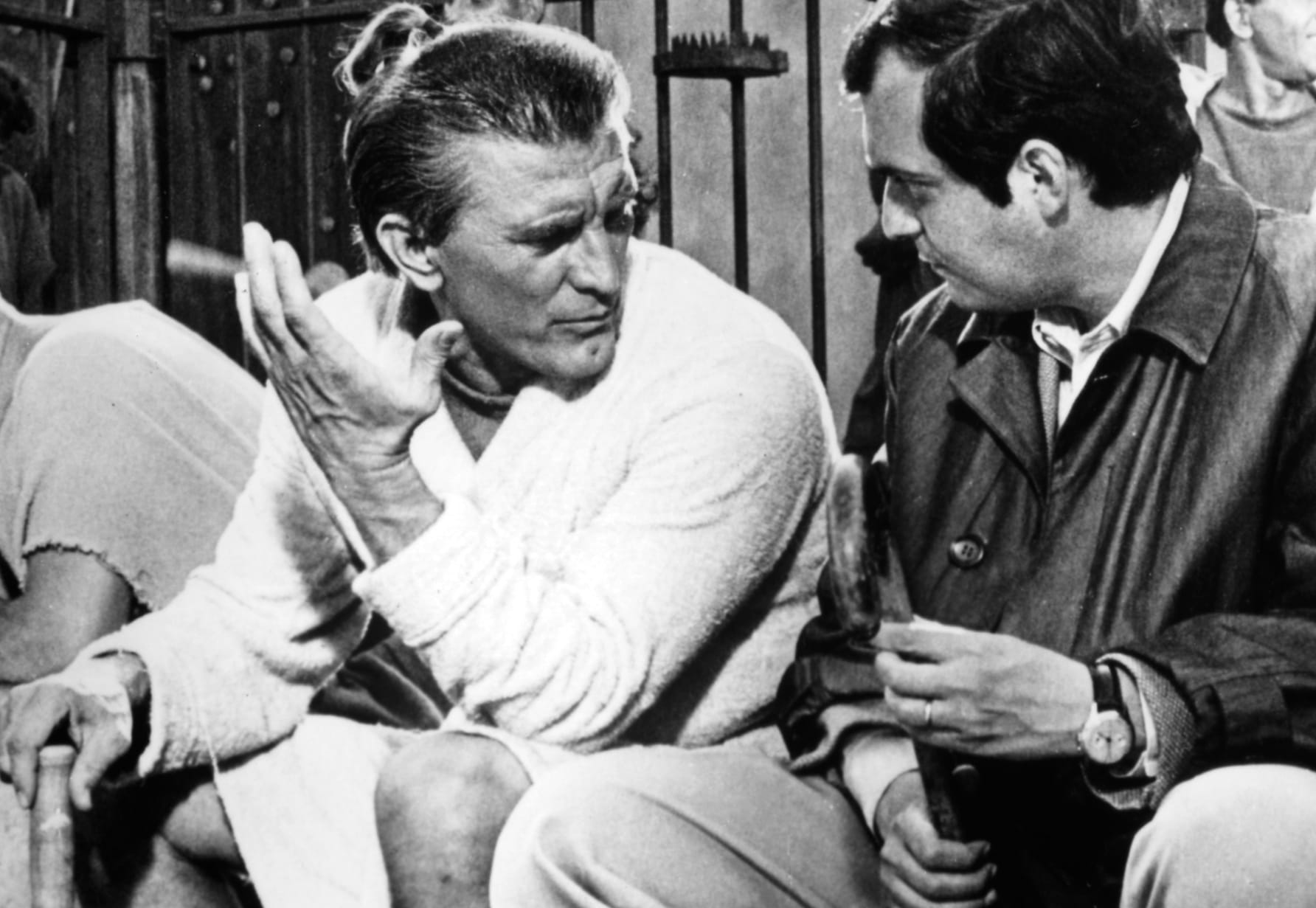
Of all the actors to try their hand at producing, Kirk Douglas may have been the most audacious. Spartacus illustrates his taste for unorthodox material, and the story behind the making of the movie reveals a great deal about Douglas’ feisty, combative spirit. The movie actually came into being because of a part he didn’t get to play. Douglas craved the title role in Ben Hur, but director William Wyler wanted Charlton Heston as the stalwart hero and offered Douglas the choice role of Ben Hur’s enemy, the villainous Messala. Refusing to play second banana, Douglas decided to make his own Roman epic to show up Wyler and company. As he admitted, “that was what spurred me to do it, in a childish way—the ‘I’ll-show-them’ sort of thing.”
Douglas’ answer to Ben Hur, made under the aegis of his Bryna Production Company, was unlike any other biblical epic of the decade. For one thing, it had no religious overtones at all. Douglas purchased the rights to Howard Fast’s controversial 1952 novel, which was popular reading in Communist circles. To adapt Fast’s story of an early Roman slave revolt, Douglas hired Dalton Trumbo, one of the members of the Hollywood Ten, who had gone to jail for refusing to cooperate with the House Un-American Activities Committee and had been forced to write scripts under a pseudonym for a decade afterwards. Douglas helped to destroy the Hollywood blacklist by allowing Trumbo to use his own name in the credits for Spartacus. (The screenwriter introduced one sly touch tweaking the McCarthy-era watchdogs. Near the end of the movie, after the revolt is crushed, the tyrannical general, Crassus, announces ominously, “In every city and province, lists of the disloyal have been compiled.”) Hedda Hopper denounced Douglas for hiring Trumbo, and the American Legion picketed the movie’s Los Angeles premiere. Douglas’ cheeky response was to hire Trumbo to write two more movies.
At $12 million Spartacus was one of the costliest movies of that period. The budget began to escalate when director Anthony Mann was fired after shooting had already begun and replaced by 31-year-old-Stanley Kubrick, who had directed Douglas’ production of Paths of Glory two years earlier. Kubrick was a hired gun on the movie, not an auteur, but he showed his talent in a number of inventive sequences. The gladiatorial bouts, sometimes shockingly violent, have a vivid immediacy, and the climactic battle between slaves and Roman legions—with some 10,000 extras filling the scene—has a truly breathtaking grandeur.
Kubrick worked well with the high-powered cast. Douglas has often been underrated as an actor. Subtlety was not his strong suit, but his no-holds-barred intensity gives a genuine emotional charge to Spartacus’ impassioned tirades. However, the real vitality in the moive comes from the three British actors—Laurence Olivier, Charles Laughton, and Peter Ustinov—playing characters far more conniving than the noble Spartacus. Aided by Trumbo’s sharp dialogue, these three old pros capture the down-and-dirty machinations of power politics in ancient Rome—or contemporary Washington, for that matter.
Ustinov won an Academy Award for his polished portrayal of the obsequious, cowardly, wily slave-trader Batiatus, but he is matched by Olivier as the haughty Crassus and Laughton as the pragmatic Republican Senator, Gracchus. (The scene in which Ustinov and Laughton discuss the virtues of corpulence is a witty gem.) The film was also honored for its spectacular cinematography, art direction, and costumes, though Alex North’s marvelously varied score was regrettably overlooked.
In 1991, Robert A. Harris, who had also supervised the restoration of Lawrence of Arabia, brought out a fully restored Spartacus. A few moments of graphic violence were retrieved, along with a suggestive homosexual scene, in which Olivier’s Crassus is bathed by one of his slaves (Tony Curtis) and hints at his Catholic sexual tastes by explaining that a gentleman may harbor a yen for both snails and oysters. (The censors considered the innuendoes too racy but did suggest changing the comparison to “artichokes and truffles.”) The daring ventures into eroticism and violence both prefigured and paved the way for later epics like Lawrence of Arabia and Gladiator, films that would be inconceivable had Spartacus not brought an adult sensibility and genuine filmmaking flair to a genre previously steeped in piety and puerility.