Slacker’s Oblique Strategy
One of my favorite things about this column is the opportunity it gives me to put in a word on behalf of an overlooked or underrated classic: a book or film that may have gotten respectful attention when it came out, but deserves more now. Deserves not just celebration for the way it’s “held up,” but for the way it’s grown since its debut in the sense that time and repeated reading or viewing have disclosed layers and depths not necessarily apparent on the first encounter.
Such a film is Slacker, a film that was either dismissed (or appreciated) as an amiable satire of Austin hippies, heads, coffee-bar layabouts, and beer-garden lounge lizards. A dismissal that can be attributed to one of the film’s subtle strengths: to what it describes in a self-referential episode as its “oblique strategy.”
It’s an obliqueness that disguises the fact that, despite its Texas college-town setting, its cosmic-shitkicker accents and characters, Slacker is at heart a very Russian film. Not just in its obvious kinship to Oblomov, Ivan Goncharov’s great nineteenth-century Russian novel, the classic celebration of the luxuriant pleasures of lethargy and the sensual delights of the contemplative life. There’s another Russian link, to Turgenev and his novels of the “superfluous man.” (And, to make a cross-cultural comparison, there’s a link as well to the seventeenth-century British pastoral “poetry of retirement” tradition, whose varieties are best limned in a volume with the lovely title The Garlands of Repose by the scholar Michael O’Loughlin.)
But on a deeper level, the true Russian kinship is less with Goncharov or Turgenev than with Dostoyevsky, to a novel like The Brothers Karamazov: the kind of novel that is unashamed in its preoccupation, its obsession, with ultimate philosophical and metaphysical questions.
The link is not obvious, because Slacker addresses these questions with a sly sense of humor, an affectionate mockery of its slacker philosophes that disguises its love for the deeper questions they’re obsessed with. Made in 1990 for a reputed $23,000, remembered more for its role as harbinger of the independent-film movement than its intrinsic merits, Slacker is a brilliant tribute to bohemian cerebration and metaphysical speculation: the coffeehouses and beer gardens of Austin are stand-ins for the agora of Athens.
Of course, there are some pure comic satiric moments that still hit home: The sequence featuring a woman selling what she claims is “Madonna’s Pap smear” may be the most acute comment ever on the ludicrousness of celebrity worship.
But let me return to the notion of “oblique strategies.” To put it in the context of the film, Slacker consists of a series of interrelated episodes—mostly conversations, riffs, raps, and rants. They begin with its writer-director, Richard Linklater, playing a guy taking a cab from the Austin bus station into town and telling a silent cabdriver about a strange dream, a dream in which “instead of anything . . . going on, there’s nothing going on”—a harbinger of the movie’s contrarian discourse on the virtues of inaction, the virtues of, frankly, sitting around talking. Sitting around talking about creation rather than mindlessly “creating.” (Toward the close of the film, one character describes himself as an “anti-artist,” one who likes “to destroy other people’s artwork.”)
Anyway, Linklater, the director playing the guy who ”should have stayed at the bus station,” goes on from recounting his nothing-happens dream to posing (to the patient cabdriver) the epistemological problem that dreams pose—the problem first raised as the ultimate refutation of realism by the pre-Socratic Athenian skeptics in the fourth century BC: No one can be certain whether one’s dream is the reality, or whether the life one seems to be living is the dream.
All of this is delivered in an easily mockable “like, man, you know, dude” lingo that gets mileage from the mockery, but nonetheless insinuates these ultimate questions into the film. Questions that range—in Linklater’s cab monologue alone—from the ancient epistemological problem to the current debate over the Anthropic Cosmological Principle, one articulated first, I believe, by a cosmologist based at the University of Texas at Austin. (Not an accident, I think.)
Anyway, I digress. To return to the structure of Slacker—which is, come to think of it, a serial digression, a digression about digression, meta-digression—Linklater, as the guy who ”should have stayed at the bus station,” arrives in downtown Austin and witnesses a hit-and-run accident. We then follow the guy in the hit-and-run car. We see him being arrested, and then we follow a guy who witnesses the arrest to a coffee shop, where we listen to another guy at a neighboring booth. This guy (identified in the credits as “Dostoyevsky wannabe”) is asking his friends, “Who’s ever written the great work about the immense effort required in order not to create?”
This riff is somehow his take on The Gambler (Dostoyevsky’s novella), a take that evolves into his Principles of Noncreation, which include “intensity without mastery” and “the obsessiveness of the utterly passive.” He goes on to celebrate “opportunistic celibacy” (which means, I think, if you can’t get laid, turn no-sex into a principle) and the “renunciation of all human endeavor.” It’s a pose that—characteristic of Slacker—is both satirized and savored. Frankly, I like the idea that we could all do with doing less. That the doers of the world are more likely to cause destruction and horror than the nondoers.
Anyway, the film ambles through Austin by way of this interlinked series of riffs and rants. There’s a video-terrorist type who advocates that the workers of the world adopt a Lazy Man’s Marxism. He’s in favor of workers not working at all, not making things at all: “Every single commodity you produce is a piece of your own death.” There’s a guy who claims to be a veteran of the Spanish Civil War who fought with Orwell and the anarchists’ brigade, but turns out to be a nondoer of another sort: he’s utterly faked or dreamed up this heroic past, and he talks such a good game of it that you wonder whether it made a difference that he wasn’t there with Orwell.
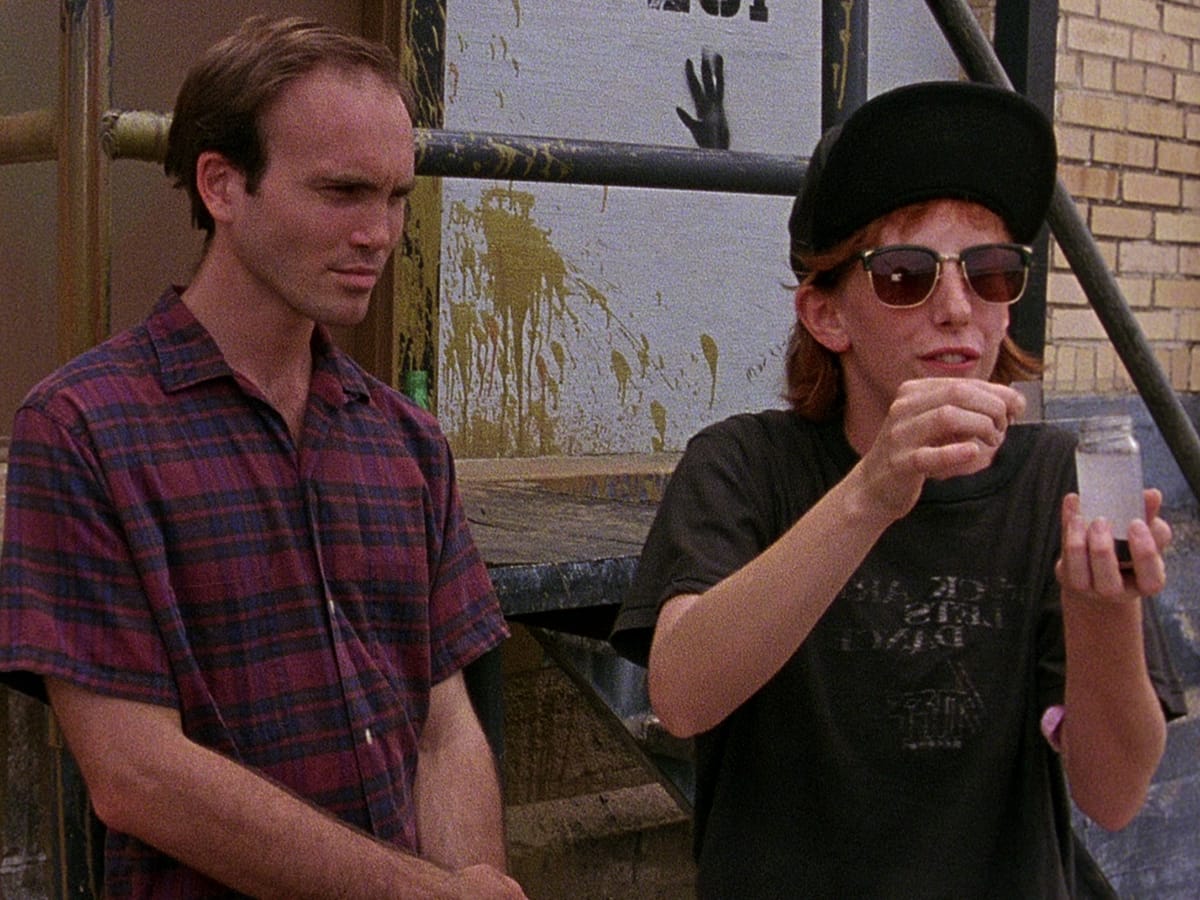
All these links in the Great Chain of (Non-)Being, all these talkers of good games, eventually lead, about two-thirds of the way through the movie, to the “oblique strategies” sequence. This woman in sunglasses is standing in a lot, offering cards to passersby. She says laconically, “Oblique strategies.”
We see a few takers read the oblique strategies on their respective cards. One (very likely my favorite, and perhaps the signature line in Slacker) is: “Withdrawing in disgust is not the same thing as apathy.” Again, a knowing tribute, a satirically expressed philosophical rationale for lethargy or, if you prefer, principled laziness.
Then there’s “It’s not building a wall but making a brick,” which I believe in philosophic terms might be seen as an anti-teleological ethic. Ambitious focus-on-the-future mentality distracts us from apprehension of the infinite dimensionality of the Here and Now in our hands, in front of our eyes.
And finally, “There is no structure. The underlying order is chaos,” which devolves into a muddled discussion of chaos theory. This oblique strategy can be seen as a self-referential characterization of Slacker itself: it appears to have no structure, to be chaotic (a matter of random encounters), when, in fact, it has a very subtle, extremely well-crafted structure that makes it a portrait of chaos. But there’s a difference between a portrait of chaos and chaos—a difference often called art. Even if it sometimes goes under the guise of anti-art.
This piece originally appeared in the New York Observer, August 13, 2001. It is reprinted here with permission of the author.

More: Features
James Baldwin Looks Back
The illuminating 1982 documentary I Heard It Through the Grapevine follows the celebrated author on a journey through the American South, as he attempts to reckon with the legacy and losses of the civil rights movement.

Small Town, Big Money: Capitalism Runs Amok in Turumba
In Kidlat Tahimik’s playful and unpredictable film, a Philippine village is tasked with manufacturing thousands of figurines for the Olympic Games, upending the lives and customs of the local population.

The Sudanese Film Group’s Legacy of Political Resistance and Creative Liberation
The members of this influential leftist collective created a formally adventurous body of work that examined the nation’s tumultuous history through a postcolonial lens.
Get Me Out of Here: Harry Dean Stanton in Straight Time
In one of his greatest performances, the celebrated actor shows off his range by fusing the two modes that defined his career: the misanthropic provocateur and the soulful survivor-witness.