Videodrome: Make Mine Cronenberg
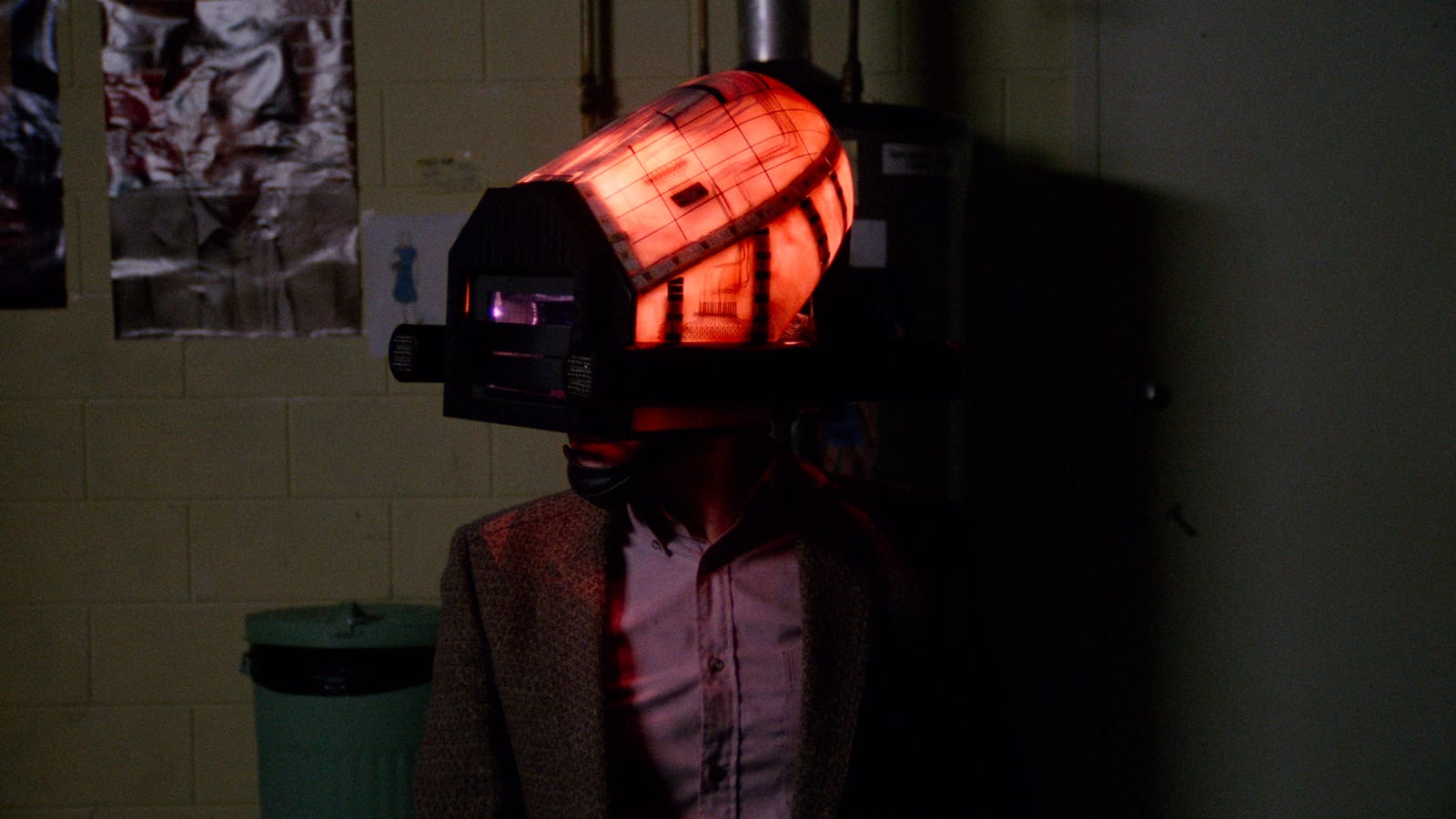
Although it wasn’t obvious upon its release in 1983, Videodrome is a key work in the David Cronenberg oeuvre. For this Virgil among filmmakers, our personable guide to bio- and cyberhell, this movie about how technology alters its users was not only prophetic but a personal artistic breakthrough.
Prior to Videodrome, Cronenberg had been concerned with the external side effects of so-called medical advances. By inviting us to consider both the physical and psychological repercussions of new technologies, Videodrome anticipated Cronenberg’s mature masterpieces The Fly (1986) and Dead Ringers (1988). By taking us on the odd odyssey of a man who lives more in his mind than in the physical world, Videodrome likewise prefigures the later Cronenberg films Naked Lunch (1991) and Spider (2002).
You could mistake Cronenberg for an accountant. Articulate, modestly professorial, and as tidy as his native Toronto (“Relentlessly clean,” boasts the Ontario Ministry of Tourism in a welcome brochure), the filmmaker writes and directs brilliantly speculative feats of technological and physiological imagination messy with comic prescience. His fans include John Carpenter (“Cronenberg is better than all the rest of us combined”) and Martin Scorsese (“No one makes movies like his”). Yet it was not until the release of his fourth genre picture, Scanners, in 1981, that he became a cult director with fans in the U.S.
Scorsese’s remark is an understatement: no one else possesses Cronenberg’s warp of mind. His movies are vividly cerebral and visceral, a killer combination in the horror genre, which typically exploits one register or the other. His originality is in visualizing thought via gutsily graphic means and in rendering unthinkable violence even more extreme through hallucinatory abstraction. Cronenberg makes the cerebral visceral and vice versa. Videodrome proposes a vision of the world made flesh, its skin the epidermis of breathing, pulsating, polyresin cassettes.
What am I ranting about? For those unfamiliar with the Cronenberg oeuvre, the simplest description of Videodrome will read like a foreign language. Best to work up to it slowly. To start by recapping Cronenberg’s biography and his quartet of bio-horror comedies, movies of such visionary science that they combine a postdoctoral biologist’s fanciful prognostications with the consciousness-razing of a strong tab of acid.
Born in 1943, the son of a journalist father and a musician mother, Cronenberg began as a biochemistry major at the University of Toronto, then transferred to the English department. Under the influence of New York vanguardists Kenneth Anger and Ed Emshwiller, he was inspired to make 16 mm underground shorts, and showed them at the same venues as his colleague and countryman Michael Snow.
Cronenberg’s first aboveground feature, They Came from Within (a.k.a. Shivers, 1975), details the creation of Wilhelm Reich–inspired aphrodisiacs, sexual parasites meant to intensify coitus as they simultaneously assume the functions of diseased organs. Like many of the premises Cronenberg has created for his movies, positive parasitology was actually being explored by biochemical engineers, many of whom were surprised to see themselves in a no-budget genre movie from the wrong side of the 49th parallel.
“I thought I invented it, and it turned out to be true,” Cronenberg said with a laugh over dinner in New York in 1983. “I’m too lazy to do research,” he confessed, “but it often happens that events in my movies correspond to experiments I know nothing about, and scientists can’t believe it.” As in many Cronenberg scenarios, physio- and pharmacological advances are attended by unexpected side effects. They Came from Within’s parasites—tonguelike, six inches long, both phallic and excremental—spread like herpes through Toronto high-rises, turning their hosts into wild-eyed satyrs and nymphomaniacs hot to broaden the scope of the sexual revolution. Or is that devolution?
This meditation on where sexual theory and practice meet was followed by Rabid (1977), about entrepreneurial doctors who open a plastic surgery franchise, a fast-medicine equivalent of McDonald’s. They assume that all tissue is undifferentiated, taking on the characteristics of the environment where it is grafted. This is rudely disproved when an accident victim under their care (played by porn star Marilyn Chambers) awakens from surgery with a phallus/syringe having sprouted from her armpit. This leaves her with an unflappable erection and an unquenchable desire to extract blood with it, rendering her the first high-tech female rapist/vampire.
The body is an endless source of joy and terror for Cronenberg, and in his most audacious work, The Brood (1979), EST-type psychology is parodied for its emphasis on the physical expression of emotions. Nola (Samantha Eggar), the patient of a “psychoplasmics” guru (Oliver Reed), literally gives birth to her anger by materializing her neuroses ectopically. She gestates rapidly growing fetuses that mature and come to pummel the objects of her hostility, including her husband, in this expressionistic, seething counterpart to Kramer vs. Kramer. With his droll sense of what is truly most terrifying, Cronenberg gives new meaning to the concept of self-actualization.
Cronenberg’s recognition that abstract emotions are jarringly potent when imagined in graphic, kinesthetic terms led him to Scanners and its fascination with the positive and negative effects of drug treatments. Its narrative features children of DES- and thalidomide-medicated mothers, progeny who are both cursed and blessed. In their maturity, they develop telepathic powers that enable them to download the central nervous systems of other individuals and even computers. (And this was a good fifteen years before downloading was in the common parlance!) These “scanners,” or telepaths, can express their power constructively, to silently empathize with their friends, or destructively, as by exploding the brains of suspected enemies.
If a director such as George A. Romero socks the horror genre by replacing the fear of death with the image of a culture that is deathlike (viz., Night of the Living Dead), Cronenberg counterpunches by refusing to recognize death as fearful. Cronenberg makes passé the horror-movie axiom, passed down from Alfred Hitchcock to Romero to Carpenter, that pathology is localized—but spreading. In a Cronenberg film, pathology is never comfortably external. It doesn’t come from Mars or from communism, the way it did in fifties movies. Nor does it rage like an unkillable zombie virus, in the way that seventies and eighties films symbolized the effects of radiation and AIDS.
In a Cronenberg film, pure pathology is often indistinguishable from pure pleasure—and their common source is the body, whether it’s the mutated torso of James Woods in Videodrome or that of Jeff Goldblum in The Fly, the mangled forms of the car-crash victims in Crash (1996) or the mangled psyche of the title character in Spider. They Came from Within summarizes the disruptive power of Cronenberg’s films. The director is extreme enough to suggest that disruption isn’t necessarily a bad thing.
Riddled with such paradoxes, Cronenberg movies are unforgettable manifestos on how attempts at corporate control inevitably result in corporate anarchy, and vice versa. You could get a brain cramp from trying to tease out whether a Cronenberg scenario privileges repression or expression.
Almost invariably in a Cronenberg film, the drug or the technology or the invention has both generative and destructive effects. For instance, in Scanners, the business monoliths that would capitalize on the inventions of Cronenberg’s scientific visionaries meet with biological insurrection. But such inversions of what is generative and what is destructive often make it hard to trace whether Cronenberg’s exploding heads, abdomens fecund with raging monsters, and bodies sated with pleasure are the result of physical expression, monolithic repression, or some dynamic dialectic between the two. At moments in his movies, expression is repression, and what was dialectic a blink ago devolves into doublethink.
This has led Cronenberg’s critics (most vociferously, the otherwise astute Robin Wood) to accuse the director of encouraging a hatred of the body, of being a vendor of spectacles deploring liberal sexuality and science, of creating images of predatory women who are transmitters of virulent pathology.
While I understand such criticisms, they make sense only if you’re repelled by Cronenberg’s imagery. I find it a grotesquely beautiful—and often hilarious—analogue of the unconscious. Rather than viewing Cronenberg as a perpetrator of reactionary exploitation, I see him as the visionary architect of a chaotic biological tract where mind and body, ever fighting the Cartesian battle for integration, are so vulnerable as to be easily annexed by technology. In order to read Cronenberg, you have to contend with his obsessive eloquence in showing the body as our only weapon against dominance. He defines body as something engaged in violent interdependence with the mind.
The bizarre and troubling mutations of body and machine manifest in Cronenberg movies graphically illustrate the way he intentionally exteriorizes the body’s functions of processing information, absorbing medication, and operating technology. Far from advocating repression, his films argue that the revolution begins at home—right in our central nervous systems and psyches.
In Videodrome, Cronenberg identifies power structures that are, essentially, invisible. While exalting the awesome dynamics of the body—its sexual energy, its capacity for the extrasensory, its suggestibility—he implies that the body is a transient state between individual existence and the creation of a “new flesh” for which the television screen is, literally, the retina of the mind’s eye. In the trancelike, confounding universe of Videodrome, the only way to resist eradication is to transform oneself into pure electronic energy. Understand that Videodrome was released sixteen years before The Matrix.
“Sounds too McLuhan to you?” challenged Cronenberg as I attempted to sort out Videodrome’s cluttered iconology. “Well, you know McLuhan was from Toronto . . . ,” the director noted of the media theorist who said, “The medium is the message.” (As to whether there’s something intrinsically Torontonian to Marshall McLuhan’s and Cronenberg’s visions of life mediated by media, it’s worth mentioning that the Canadian director Atom Egoyan is likewise obsessed. But that’s another essay.)
I don’t pretend to fully comprehend the film, which plunges into the cathode-ray beam that Poltergeist only dipped a toe into, but Cronenberg certainly provides us with palpable images of how television transforms the human body. What’s Videodrome about? In a phrase: sadomasochistic sex as an altered state and the videocracy that more directly governs our lives than any elected official. It is a prescient work of art: what was satire in its own day has turned out to be eerily accurate in its prediction of the TV landscape at the millennium, with its reality shows that suggest public life on TV is “more real” than private life in the flesh.
Centrally, Videodrome is about those who would control access to all broadcasting, who can unscramble all the scrambling devices, who can wash all the satellite dishes and incrementally coerce all TV dropouts to tune in. Led by a benign-looking despot named Barry Convex, these cable totalitarians revel in the fact that they can search for and destroy their natural adversaries because thrill-seeking counterculturalists are easy marks for hidden signals beamed during more radical television entertainments. Videodrome is the 1984 blueprint contextualized.
Mystifying? Videodrome exalts technology while excoriating technocracy, painting a dystopian picture. It is at once a baffling and entirely credible depiction: Cronenberg expresses what is usually repressed and makes visible those networks of power not seen by the naked eye. “If you’re a wishy-washy Canadian liberal,” sighed Cronenberg, “who’s the enemy? . . . I don’t have a moral plan—I’m Canadian.”
Yet there’s a dazzling glimpse of Cronenberg’s morality in Videodrome, the ultimate commitment to comprehending how the reality delivered by the media affects us figuratively—and literally. Videocassettes anthropomorphize—this was a decade before people talked about “virtual reality” but just before Cronenberg worked on a screenplay called Total Recall, which became an Arnold Schwarzenegger blockbuster. TV reaches out to touch you—your body becomes the television apparatus. Early in the twentieth century, painter Paul Klee proposed that art was not the reproduction of reality but the invention of it. Cronenberg’s revision of that is that art should identify reality. Then enlarge it.
Cronenberg films raise compelling questions—deep, philosophical ones in which the issues of metaphysics, phylogeny, psychology, and technology meet. Decades before biologist Donna Haraway hypothesized that human dependence on computers and cell phones had made our species a human/technological hybrid, Cronenberg mapped it in Videodrome.
A version of this essay appeared in the Village Voice in January 1983. This version of the piece originally appeared in the Criterion Collection’s 2004 DVD edition of Videodrome.

More: Essays

Sentimental Value: Between Trauma and the Sublime
In this powerful drama about family and memory, Joachim Trier explores how the past lives on in us, shapes us, and partly determines who we are and how we feel.

Lenny: High-Wire Act
Featuring a quasi-documentary format that was innovative for its time, Bob Fosse’s complex portrait of stand-up comedian Lenny Bruce is a gesture of postmortem outreach from one prickly, jagged-edged artist to another.
Fresh Kill: Fluid Transmission
New-media pioneer Shu Lea Cheang’s astonishingly prescient dystopian vision takes place in a world where technology feels sticky and bodily, and where networks seep into food, water, and flesh.

Body Heat: The Trap You Set for Yourself
In his stylish and provocative directorial debut, Lawrence Kasdan uses the vehicle of a sex-and-murder plot to explore the film’s historical moment, which gave rise to the greed and amorality of the Reagan era.