Excess in Stray Dog
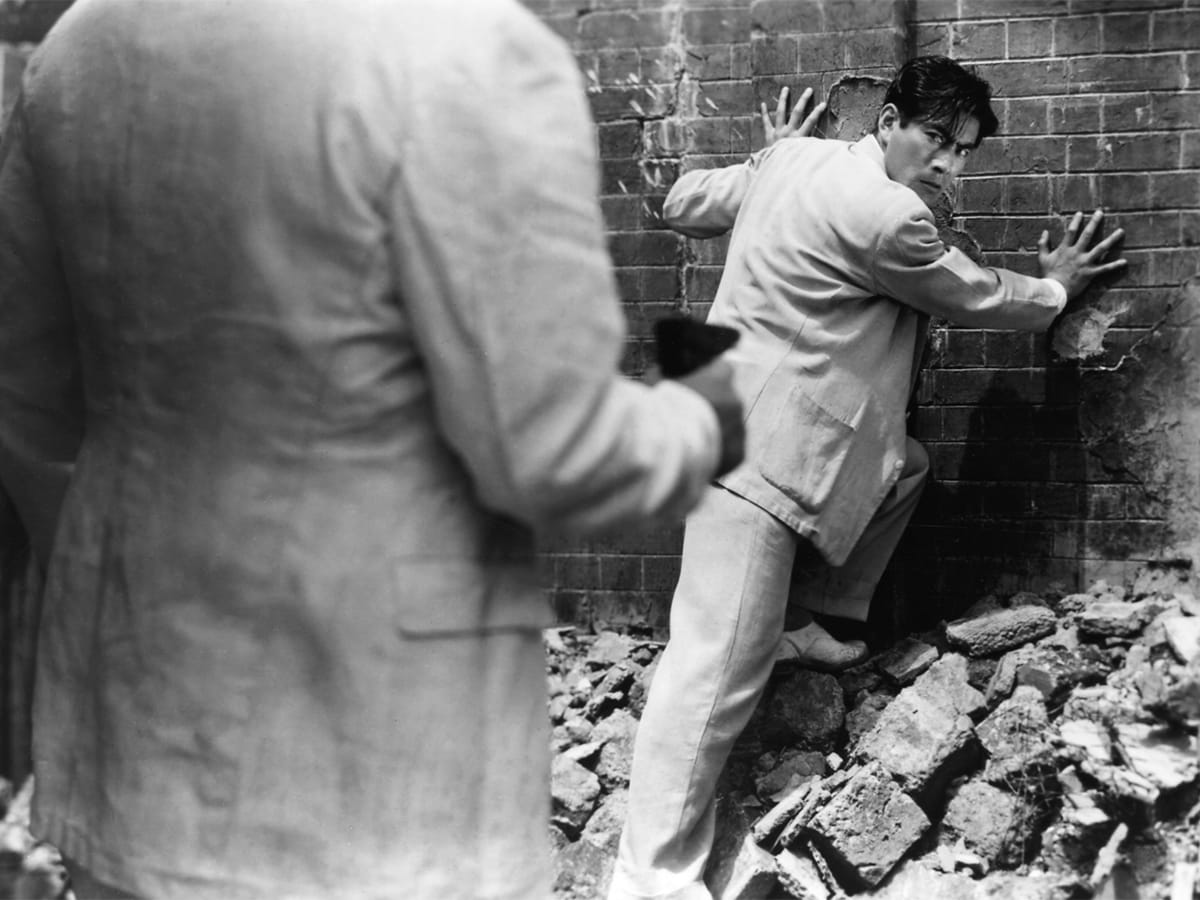
Stray Dog is above all a film of atmosphere. The film establishes right away that it’s hot in Tokyo, and never lets us forget it for a second. By piling on naturalistic details to keep the heat constantly in our minds—fluttering fans, the mopping of brows, a cop hitting the back of a witness’ electric fan to make it oscillate between them—Akira Kurosawa creates a visual and behavioral excess that highlights the fixation of his hero, police detective Murakami (Toshiro Mifune), on retrieving his stolen gun.
The excess in the film is also stylistic. Although the director himself rejected the film as “too technical,” Stray Dog is a great success of style. Through the constant unfurling of interposed surfaces (multiple superimposed images, the strips of mesh and garlands down which the camera cranes at the Wellesian Blue Bird club), Kurosawa evokes a world in perpetual motion. But by dwelling so fixedly and at such length on their labyrinthine interplay, Kurosawa implies that for all its dazzling contrasts, this world, like Murakami, is stuck. Only the rain can release it, and we wait, with the characters, for the freeing cloudburst.
The sequence in Stray Dog in which Murakami goes undercover in the streets of Tokyo to look for the gun lasts slightly over nine minutes—much longer than necessary to advance the plot and convey that his search goes on for some time. The feeling of excessive length comes from the lack, or the randomness, of variation: the viewer’s main impression is the ever-dawning awareness that the sequence has nothing new to give. Kurosawa’s intention is to heighten our identification with Murakami as he slogs through the lower depths. By immersing us in the world’s chaos so thoroughly, the director makes us rely all the more on Murakami’s obsession as a potential source of meaning and order, while at the same time showing how inadequate it is to pose the problem of this chaos in the specific terms of a missing gun.
In one passage of the undercover sequence, Kurosawa holds on an extreme closeup of Murakami’s eyes. Over this shot, other images are superimposed: Murakami’s feet as he walks the pavement, shots that tilt down from the skyline to milling city dwellers, an overhead shot of a crowded street. This succession of images implies a succession of times. But by keeping the shot of the eyes as a constant underlying layer, and returning to it when the other images disappear, Kurosawa cancels the implied temporal movement. The main principle of the sequence is indifferentiation: superimpositions recombine spaces and points of view; various times melt into a simple repertory of experience; Murakami becomes one with the crowd.
The implication of “we’re all in this together” is affirmed earlier in the film, when the woman pickpocket whom Murakami has been following all day takes pity on him and buys him a beer, then lies down next to him and comments on the beauty of the stars. But just as no two stars are alike, no two destinies are alike, and this is Kurosawa’s main point. Look again at the long undercover sequence: the sheer number of anonymous subjects who cross the camera’s vision is bewildering. By hinting at the myriad of actions, stories, concerns, and outcomes that come into contact, however fleetingly, with Murakami’s quest, Kurosawa suggests the multiplicity of possible individual solutions to the problems raised by the film.
Its openness to this multiplicity is a key aspect in which (despite surface similarities) Stray Dog differs from American film noir. Violence as catharsis; the possibility that physical action can solve, by metaphor, a political, social, or moral problem; the ability of individuals to perform acts that have symbolic validity for their societies—these are the basic conditions of American action cinema, including that hybrid or offshoot or mutation labeled film noir. In Stray Dog, action solves no wider problems—only the immediate ones of recovering the gun and catching the criminal—and yields no release. It’s tangential to the larger sphere of society, as Kurosawa stresses in the climactic sequence by shifting our attention from the cop and the culprit to a young woman practicing piano nearby; and even within its own sphere (of narrative cause and effect), it is unsatisfying and inconclusive, as Kurosawa makes us feel by lingering on the murderer’s tortured scream and, in the final shot, on Murakami’s silent gaze out the hospital window.
Kurosawa’s great originality with rhythm and structure is most evident in this final section: the rain finally comes, bringing a logical end to the film, but the film continues, tracking the object of Murakami’s obsession across a series of now-liberated landscapes to which his quest is irrelevant. It’s in its suggestion, through a multiplicity of rhythms, textures, and moods, of the range of human possibilities and of multiple worlds that ignore each other, that Stray Dog is most fervent and haunting.
More: Essays
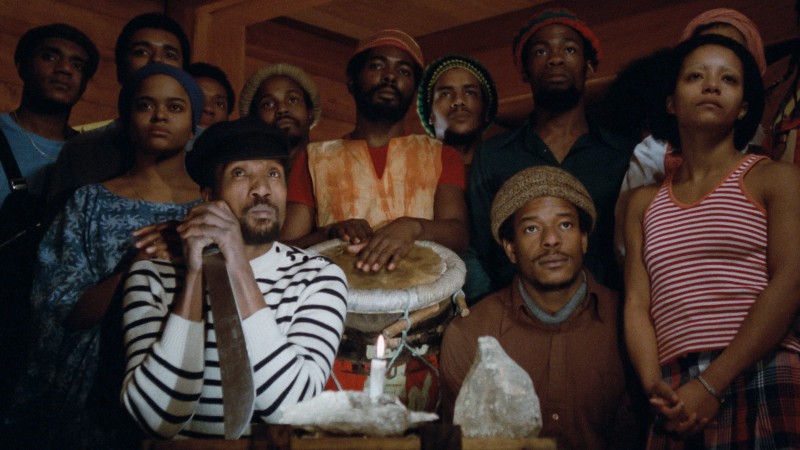
West Indies: The Fugitive Slaves of Liberty: Torrents of Fire, Torrents of Blood
Unfolding in a blaze of vivacious color, Med Hondo’s musical masterpiece is a wildly ambitious exploration of the history of French colonial aggression, the enslavement of African peoples, and their subsequent liberation struggles.
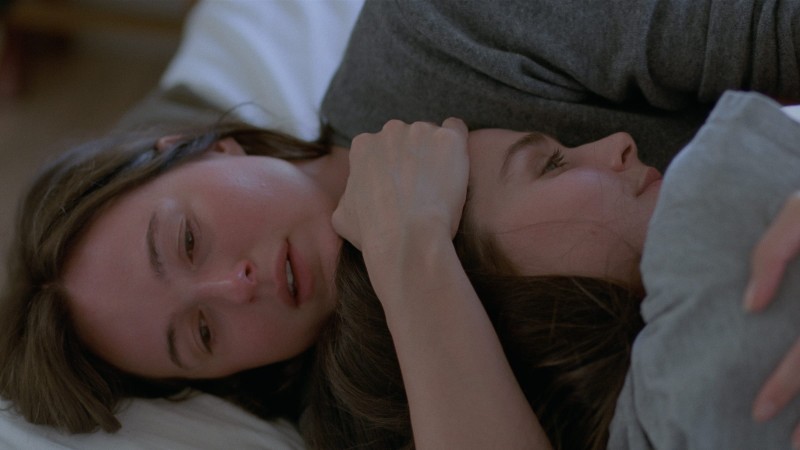
Sentimental Value: Between Trauma and the Sublime
In this powerful drama about family and memory, Joachim Trier explores how the past lives on in us, shapes us, and partly determines who we are and how we feel.
Lenny: High-Wire Act
Featuring a quasi-documentary format that was innovative for its time, Bob Fosse’s complex portrait of stand-up comedian Lenny Bruce is a gesture of postmortem outreach from one prickly, jagged-edged artist to another.
Fresh Kill: Fluid Transmission
New-media pioneer Shu Lea Cheang’s astonishingly prescient dystopian vision takes place in a world where technology feels sticky and bodily, and where networks seep into food, water, and flesh.